How to design a wooden villa: Finnish craftsmanship & timber
TL;DR:
- Finnish log construction balances eco-conscious materials, strict permitting, and winter durability.
- Permitting requires comprehensive documentation, including site plans, energy, and climate studies.
- Proper design choices, such as steep roofs and precise log details, prevent costly mistakes.
Building a custom wooden villa in Finland is one of the most rewarding construction journeys you can take, but it is also one of the most layered. You are balancing eco-conscious timber choices, strict municipal permitting rules, and an architectural vision that must hold up against Finnish winters. The good news is that Finnish log construction has evolved over centuries into a craft that handles all three challenges at once. This guide walks you through every stage, from early documentation to final design decisions, so you and your architect can move forward with confidence and avoid the most common, costly mistakes.
Table of Contents
- Understanding requirements and prerequisites
- choosing materials and architectural approach
- Design workflow: step-by-step process
- Common mistakes and expert troubleshooting
- Our perspective: what truly sets Finnish wooden villas apart
- explore expert guides for your villa project
- frequently asked questions
Key Takeaways
| Point | Details |
|---|---|
| Permitting is crucial | Start building permit applications early and prepare all documents to avoid costly delays. |
| Material choices matter | Choosing log stacking and notching methods ensures the villa is well insulated and eco-friendly. |
| Follow stepwise workflow | A structured step-by-step process with expert guidance prevents errors in architectural and technical design. |
| Steep roofs for safety | Design steep roofs for northern Finnish climates to ensure durability and prevent snow-related issues. |
Understanding requirements and prerequisites
Before a single blueprint gets drawn, you need to understand what Finnish law and local municipalities actually require. Many homeowners underestimate this stage, treating it as paperwork rather than the foundation of the entire project. Getting it wrong costs time and money. Getting it right early means your design process flows without unexpected stops.
The permitting timeline alone is a reality check. You must submit permits early: site plans, architectural blueprints, structural specs, energy calculations, and climate impact studies are all required, and the review process takes 4 to 12 weeks under Finnish municipal rules. That is nearly three months on the conservative end, and that clock does not start until your documentation is complete.
Here is what your pre-design documentation checklist needs to cover:
- Site plan showing the property boundary, proposed structure placement, and setback distances
- Energy calculations proving the building meets Finland’s thermal efficiency standards
- Climate impact study accounting for local snow loads, wind, and ground frost
- Log wall construction method documentation, including the specific notching technique
- Foundation specifications suited to your soil type and frost depth
- Water and sewage plan approved by the local authority
The permits process in Finland runs in stages, not as a single submission. Most municipalities use an initial application phase followed by a technical review and then a final approval. Missing a single document at any stage can reset the clock entirely.
| Document | Why it matters | Who prepares it? | When needed? |
|---|---|---|---|
| Site plan | Shows legal placement | Licensed surveyor | Application stage |
| Energy calculations | Required by law | Engineer or architect | Application stage |
| Climate impact study | Snow/wind safety | Designer or builder | Application stage |
| Log construction specs | Municipal review | Builder or manufacturer | Technical review |
| Foundation specs | Safety and frost compliance | Engineer | Technical review |
Sustainable timber sourcing is another requirement worth addressing early. Finland’s building regulations increasingly expect documented proof that structural wood comes from certified, responsibly managed forests. This is not just good ethics. It is often a permit prerequisite.
Pro tip: Start your documentation process at least six months before your target construction start date. The permitting window alone can eat a full quarter, and revisions are common.
choosing materials and architectural approach
With your regulatory checklist in hand, the next big question is what kind of log villa you actually want to build. The material and construction method you choose shapes everything: thermal performance, visual character, build cost, and even which contractors are qualified to work on it.
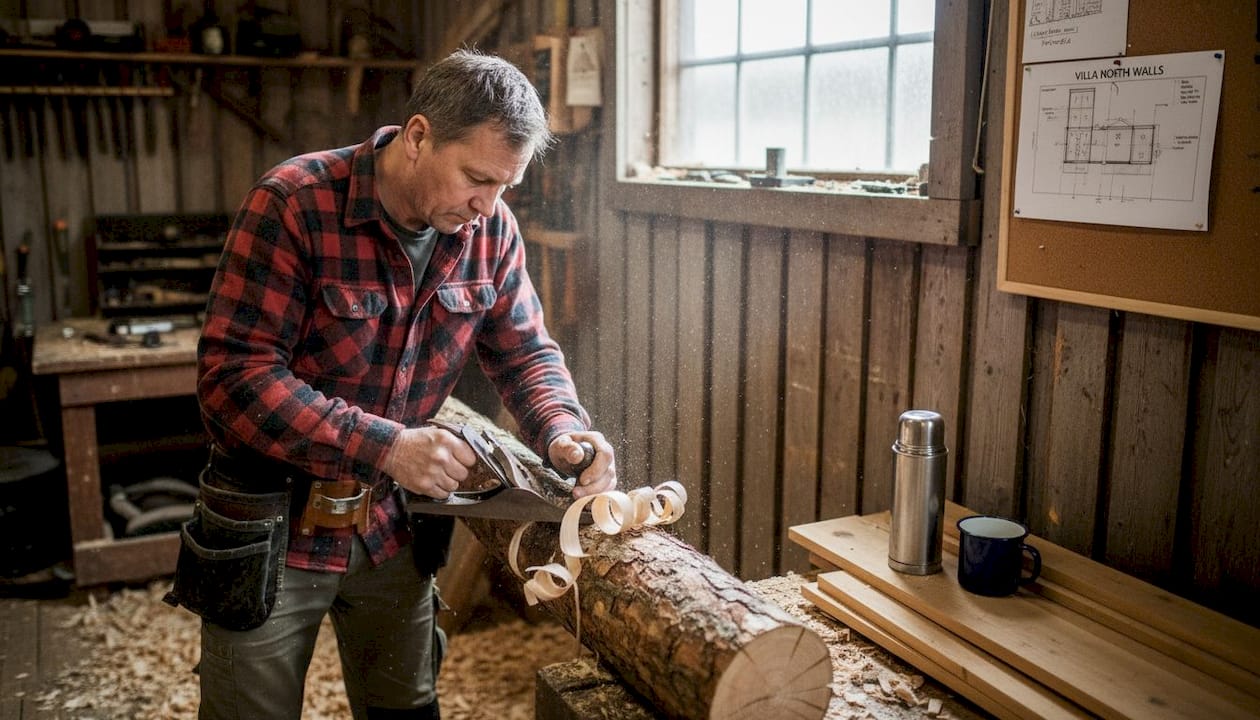
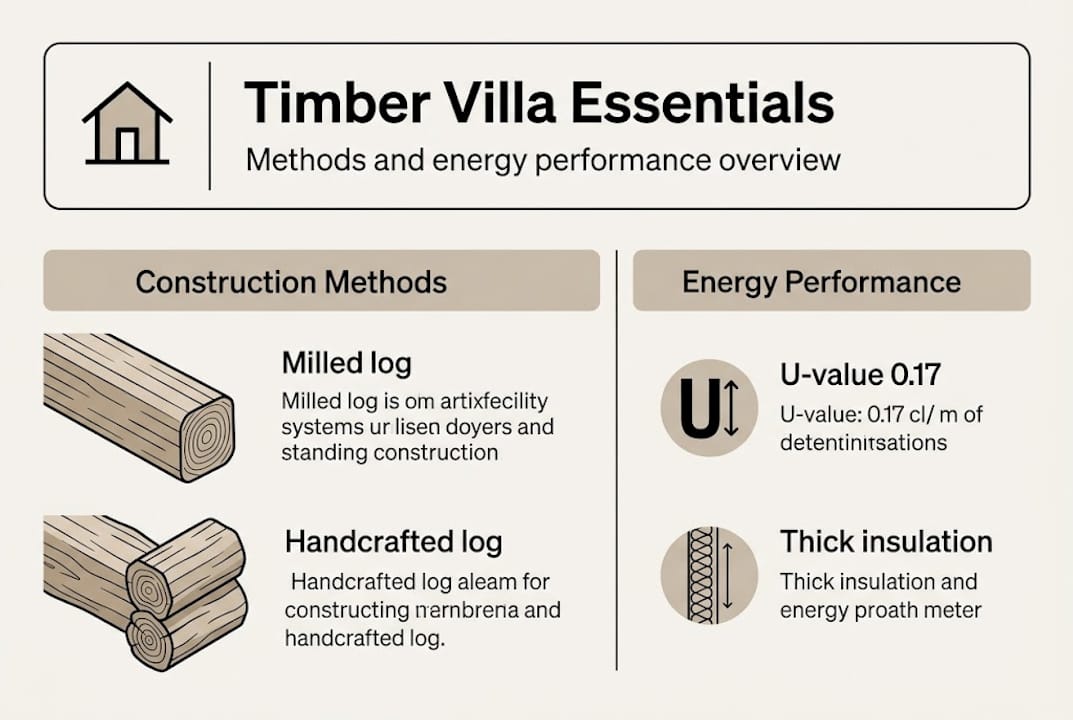
Finland offers two primary log wall construction paths. milled logs are machine-cut to uniform dimensions, giving a clean, modern look and consistent fit. handcrafted logs are shaped by skilled builders, with each log fitted individually to the one below it. Both methods use horizontal log stacking with interlocking notching (a technique called log scribing) to create airtight, insulating walls.
The thermal performance difference matters. Well-built log walls can reach a U-value of 0.17 W/m²K, which is roughly 50% better than the standard 0.41 benchmark. Log construction also carries a major sustainability advantage: Finnish timber buildings produce approximately 70% less CO2 over their lifecycle compared to equivalent concrete or steel structures.
| Method | Visual style | U-value achievable | Build speed | Best for |
|---|---|---|---|---|
| milled log | Clean, modern | 0.17 W/m²K | faster | Contemporary villas |
| handcrafted log | rustic, unique | 0.17 W/m²K | slower | Traditional aesthetic |
| thermal-enhanced log | minimal visible change | Below 0.17 W/m²K | medium | High-efficiency builds |
Roof design is where many Finnish villa projects stumble. A shallow or low-slope roof is a serious error in most parts of Finland. Snow accumulates fast and heavy, and a roof not engineered for that load becomes a structural liability within the first winter. For northern Finland especially, steep roof pitches (45 degrees or more) are not just traditional; they are functionally essential.
Here are the key architectural details to prioritize:
- roof pitch of at least 1:1 (45°) in central and northern regions
- Log scribing for proper air sealing at every horizontal joint
- Deep roof overhangs to protect log walls from water infiltration
- vapor barrier integration matched to the log species and wall thickness
Pro tip: If you are building north of the 63rd parallel, treat a steep roof as non-negotiable. The savings from a shallower design are not worth the structural risk or the heat loss.
When choosing between traditional solid logs and thermally enhanced versions, consider your long-term energy goals. Traditional logs offer greater thermal mass (they store heat and release it slowly), while thermal-enhanced logs prioritize consistent insulation values. Neither is universally better. The right log house approach depends on your site, your lifestyle, and your energy budget.
Design workflow: step-by-step process
With your materials locked in, you need a structured workflow to take your vision from sketch to stamped permit. Here is how a well-run Finnish wooden villa project typically flows:
- Site analysis — Survey your land for topography, orientation, solar gain, wind exposure, and access. This shapes every decision that follows.
- Blueprint drafting — Work with a licensed architect to produce floor plans, elevations, and section drawings that reflect your log construction method.
- Material selection and sourcing — confirm your log supplier, species (pine and spruce are most common), and certification documents.
- Energy modeling — An engineer runs thermal simulations to ensure your wall assembly, windows, and roof hit Finnish energy code targets.
- Initial permit application — Submit all documents including site plans, blueprints, specs, and energy and climate studies to your municipality.
- Technical review — The municipality’s building authority examines structural and energy compliance. This is where incomplete documents cause delays.
- Final permit approval — Once all technical comments are resolved, the permit is issued and construction can begin.
The timber construction checklist for each phase should be treated as a living document, updated as the municipality responds.
statistic to know: Log walls built to the 0.17 W/m²K U-value standard perform 50% better than the general 0.41 W/m²K benchmark, which directly reduces annual heating costs in a Finnish climate.
The most common point of delay is energy calculations submitted too late or with errors. If your engineer and architect are not collaborating from the earliest design stages, the energy model often has to be redone after blueprints are already finalized. That costs weeks.
The planning permission process also varies by municipality. Some rural areas move faster than urban centers, but smaller offices sometimes have less experience with log construction specifics. Build in buffer time regardless.
Pro tip: Ask your architect to review energy calculations before the blueprints are finalized, not after. It is much easier to adjust wall thickness or window sizing at the design stage than after the drawings are done.
Common mistakes and expert troubleshooting
Even experienced architects run into trouble with Finnish wooden villa permits. The reasons are predictable, and most are avoidable with the right preparation.
The biggest category of problems involves incomplete documentation. Municipal reviews reject applications for incomplete specs, inadequate energy studies, or improper log construction details. When that happens, the entire permitting clock resets. You do not get partial credit for what you submitted correctly.
Here are the most frequent mistakes and how to fix them:
- Missing climate impact study: Often skipped because homeowners assume the architect handles it automatically. Always confirm it is included before submission.
- Energy calculations not matching blueprints: If your blueprints show one wall thickness and your energy model assumes another, the municipality will catch it. Both documents must align.
- Low-slope roof on a snow-heavy site: This gets flagged in technical review almost every time in northern regions. fix it at the design stage.
- log notching details missing from specs: Municipal reviewers need to see exactly how logs interlock. Generic references to “log construction” are not sufficient.
- Foundation spec mismatch: Your foundation must account for your specific site’s frost depth. A generic spec imported from another project will not pass.
“The most successful villa projects we see are those where the homeowner, architect, and log manufacturer are communicating from day one. When that triangle breaks down, it always shows up in the permit review.”
For troubleshooting already-submitted applications, the fastest fix is direct communication with the municipal building authority. Ask for a written list of deficiencies and address every point in a single resubmission. Multiple partial corrections drag the timeline out further.
Review the timber permits guide alongside your municipality’s own published requirements. The custom timber permits guide is especially useful if your villa involves non-standard log profiles or unusual architectural features.
Our perspective: what truly sets Finnish wooden villas apart
After 65 years of building with Finnish timber, here is what we have observed: the projects that succeed most fully are never the ones chasing the lowest cost or the fastest timeline. They are the ones where every decision, from log species to roof pitch to notching detail, reflects a genuine understanding of the Finnish climate and the material’s properties.
Conventional advice focuses on permits and timelines. But the real differentiator is the conversation between tradition and modern performance. Traditional log construction offers thermal mass that newer materials cannot replicate: the walls store warmth and release it gradually, creating a living environment that feels fundamentally different from a framed house. thermal-enhanced logs raise the insulation ceiling, but they do not replace that quality.
What municipal review actually does is force you to make better decisions. The requirement to document everything, from energy flow to notching geometry, pushes architects and homeowners to think through details they might otherwise have glossed over. We believe that is a feature, not a burden.
Pro tip: Before finalizing your log wall specs, have someone double-check every scribing and notching detail against your permit drawings. That single alignment check has saved many projects from a costly resubmission.
Look at the full in-depth villa tutorial for the most complete picture of how to bring all of these elements together.
explore expert guides for your villa project
Ready to move from planning to action? At huvilaseppala.fi, we have spent over 65 years refining every step of the Finnish wooden villa process. Our team works directly from your drawings to produce custom log structures with no hidden costs and fast delivery.
Explore our guides on custom wooden villas to see how design choices translate into real builds. For a deeper look at the craft behind our structures, the Finnish timber craftsmanship resource covers what makes our approach distinctive. When you are ready to plan the full construction sequence, the log house step-by-step guide walks you through every phase. Contact us for a transparent, personalized quote based on your specific plans.
frequently asked questions
How long does it take to get permits for a wooden villa in Finland?
Permit approval takes 4 to 12 weeks depending on the municipality and completeness of your documentation. Starting with a full, error-free submission is the single most effective way to stay at the shorter end of that range.
what timber construction methods offer the best insulation?
Horizontal log stacking with interlocking notching (log scribing) achieves the best insulation results, with a U-value of 0.17 W/m²K, which is roughly 50% better than the standard benchmark of 0.41 W/m²K.
Should I choose a steep roof for my wooden villa?
Steep roofs are strongly recommended for northern Finland to prevent snow accumulation and water damage. A low-slope roof in a snow-heavy region is one of the most common and costly design errors in Finnish villa projects.
what are common mistakes in Finnish wooden villa design?
The most frequent mistakes include incomplete permit documents, missing climate impact studies, and inadequate log construction details in the technical specifications. All of these are avoidable with early coordination between your architect, engineer, and log manufacturer.
Recommended
- Building a Finnish Villa Tutorial: Step-by-Step Guide to Success – Hirsitalot, pihasaunat ja piharakennukset kotimaisesta hirrestä
- Role of Finnish craftsmanship in custom timber homes – Hirsitalot, pihasaunat ja piharakennukset kotimaisesta hirrestä
- Discover traditional Finnish craftsmanship for timber homes – Hirsitalot, pihasaunat ja piharakennukset kotimaisesta hirrestä
- Finnish Woodworking: Unique Features for Saunas, Cabins, and Homes – Hirsitalot, pihasaunat ja piharakennukset kotimaisesta hirrestä