Timber Building Permits in Finland: A Homeowner’s Guide
TL;DR:
- Finnish timber projects, including saunas and cottages, require permits despite common assumptions.
- The permit process involves zoning checks, detailed documentation, and can take 4-12 weeks.
- 2026 regulations introduce climate studies, BIM files, and waste surveys as standard permit requirements.
Most homeowners assume that building a small sauna or summer cottage on their own land is a permit-free affair. It isn’t. Finnish building regulations apply to a surprisingly wide range of timber projects, and the rules have grown more detailed since 2025. Whether you’re planning a log home, a lakeside cottage, or a backyard sauna, understanding what permits you need, how long they take, and what local rules override national ones can save you serious time, money, and stress. This guide walks you through everything you need to know before breaking ground.
Table of Contents
- Why permits matter for timber construction projects
- How the permit process works in Finland
- National vs. municipal rules: What owners need to know
- Key updates to timber building permits in 2026
- Our take: Smart permit strategy for Finnish timber builds
- Where to get expert support for your timber building project
- Frequently asked questions
Key Takeaways
| Point | Details |
|---|---|
| Permits are essential | Most timber building projects in Finland need permits—even small saunas or cottages. |
| Regulations are nuanced | National code and municipal rules both apply, so always check local details before starting. |
| 2026 rules add steps | Climate documents, BIM requirements, and waste surveys are now standard for many projects. |
| Process takes time | Expect 4–12 weeks for most permits and start planning documentation early for smooth approval. |
Why permits matter for timber construction projects
Timber is the backbone of Finnish residential construction. In fact, 90% of Finnish detached homes use timber as their primary material, and the country applies stricter fire and thermal rules to wood construction than most other EU nations. That context matters, because it explains why the permit system is thorough rather than bureaucratic for its own sake.
Permits exist to protect you. They ensure your structure meets fire safety standards, energy efficiency targets, and environmental requirements. They also protect your property value. A building without a valid permit can be flagged during a sale, refused insurance coverage, or even ordered for demolition by municipal authorities.
Here’s what’s at stake if you skip the permit process:
- Fines and penalty fees issued by the local building authority
- Demolition orders for structures that don’t meet code
- Insurance refusal if the structure was built without approval
- Complications when selling your property, since unpermitted buildings must be disclosed
- Loss of financing if a bank discovers the build is non-compliant
Many owners assume that size thresholds give them a free pass. A sauna under a certain square footage, a shed, a small outbuilding. But even structures that fall below national size limits are still subject to your municipality’s local building code, called the rakennusjärjestys. Local rules can require notification, action permits, or full building permits for structures that national law might otherwise exempt.
“Always check your local zoning plan (kaava) before starting. Municipality rules can and do override national thresholds, especially in shore areas and heritage zones.”
Pro Tip: Before you draw a single plan, contact your local building authority and ask specifically about your plot’s zoning designation. A five-minute phone call can prevent a five-month delay.
For a deeper look at how timber regulations in Finland apply to different project types, it’s worth reviewing the latest national and municipal guidance side by side.
Having previewed why timber building permits aren’t optional, let’s clarify what the permit process looks like in practice.
How the permit process works in Finland
The Finnish permit process follows a clear sequence, but the details vary by municipality and project size. Here are the core steps most timber projects require:
- Check zoning — Confirm your plot’s zoning designation and whether your planned build is allowed there.
- Prepare architectural drawings — These must meet national standards and often require a licensed designer.
- Gather required documents — Includes site plans, energy calculations, structural plans, and ownership proof.
- Submit the application — To your local municipality, either digitally or in person depending on local requirements.
- Respond to requests — Inspectors may ask for clarifications or additional documents.
- Receive approval and begin work — You must start construction within 3 years or the permit lapses.
The permit process steps are straightforward on paper, but the timeline depends heavily on how complete your application is from day one.
| Stage | Typical timeframe |
|---|---|
| Zoning check and pre-consultation | 1-2 weeks |
| Document preparation | 2-6 weeks |
| Permit review by municipality | 4-12 weeks |
| Approval to construction start | 1-2 weeks |
Permit processing typically takes 4-12 weeks and fees generally run 2-6% of total project cost, varying by municipality. Work must start within 3 years or the permit lapses entirely.
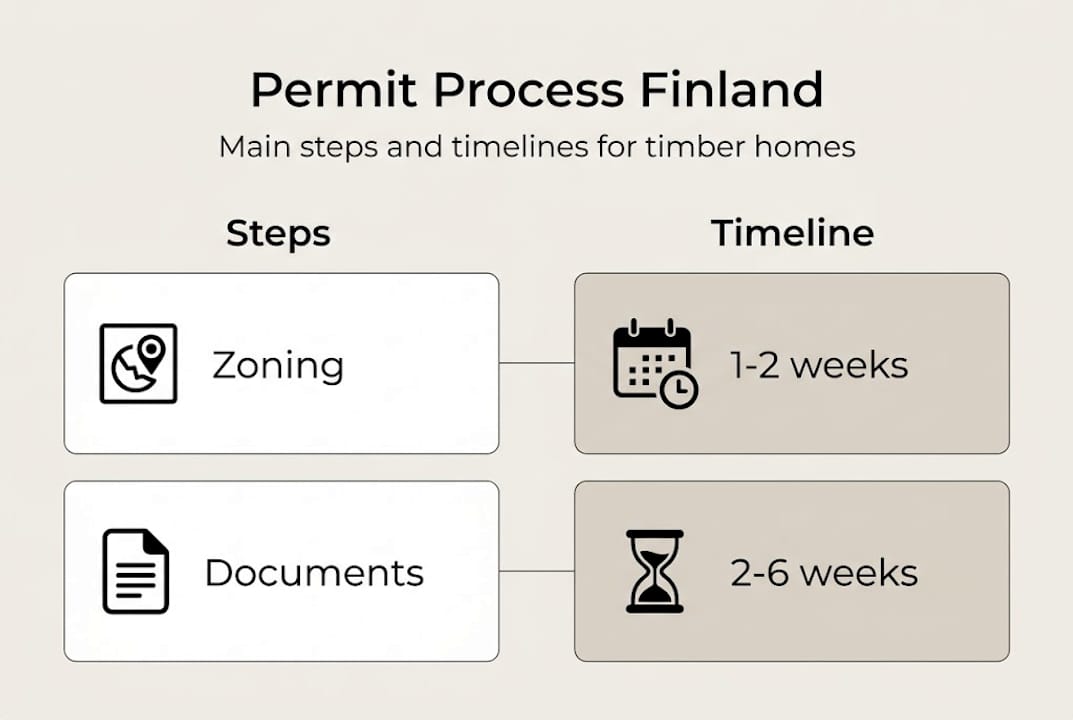
Over 80% of permit delays come from incomplete or outdated documentation. Missing an energy certificate, submitting an old site plan, or forgetting a required specialist statement can push your timeline back by weeks.
Pro Tip: Book a pre-application meeting with the local building inspector before submitting anything. They will tell you exactly what documents are required for your specific project, which prevents costly rework later.
For projects involving custom designs or non-standard log structures, a custom timber permits guide can help you prepare the right documentation from the start.
Understanding the process, however, is only part of the story. Let’s look at how regulations differ by region and project type.
National vs. municipal rules: What owners need to know
Finland’s national building code sets the minimum standards for fire safety, structural integrity, energy performance, and documentation. Every project in the country must meet these baselines. But municipalities have real power to adjust those requirements for their own areas, and that’s where many owners get caught off guard.
National law sets thresholds but municipalities can raise or lower permit requirements. Tuusula, for example, allows saunas up to 50m² outside detailed plans, while Helsinki enforces specific rules on wood facades in certain neighborhoods. Shore (ranta) areas across Finland are consistently stricter, often requiring permits for structures that would be exempt inland.
Here’s a comparison of how municipal rules can differ from national defaults:
| Requirement | National baseline | Example municipal variation |
|---|---|---|
| Sauna size without permit | Varies | Tuusula: up to 50m² allowed |
| Wood facade rules | General fire standards | Helsinki: specific zone restrictions |
| Shore area builds | Stricter than inland | Most municipalities add extra layers |
| Green factor / landscaping | Not always required | Some urban municipalities require it |
| Heritage zone requirements | General preservation rules | Local plans may ban certain materials |
For a full breakdown of national regulations for timber homes, it helps to read the national code alongside your municipality’s own published rules.
Even when a structure is technically exempt from a full building permit, the following conditions still apply:
- Zoning rules always apply, regardless of permit status
- Heritage designations can restrict materials, colors, and roof forms
- Shore protection zones require separate assessment in most cases
- Neighbor notification may still be required for exempt structures
- Utility connections (water, sewer, electricity) trigger their own permit requirements
“Exempt from a permit does not mean exempt from rules. It means the rules are enforced differently.”
If you want to avoid permit pitfalls that catch even experienced builders off guard, understanding the municipal layer is the most important step you can take.
But regulations are continuously evolving. Here’s what’s new for 2026 that you must factor into your project.
Key updates to timber building permits in 2026
The Finnish building code has been modernized significantly since 2025, and several new requirements now affect timber projects at the permit phase. These aren’t optional additions. They are part of the standard application for most new builds.
From 2025 onward, climate impact studies, full product lists, BIM digital submission, and demolition or waste surveys are required for most new construction projects. Detached houses are partially exempt from the full footprint reporting requirement, but they are not entirely free from new obligations.
Here’s what you need to prepare as a timber homeowner or builder in 2026:
- Climate impact study — Required at the permit application phase for most buildings. This calculates the carbon footprint of your construction materials and methods.
- Full product list — A documented list of all building materials used, submitted alongside the permit application.
- BIM digital submission — Building Information Modeling files are now mandatory for permit applications in several municipalities and are being rolled out more broadly.
- Demolition and waste survey — Required for large projects or builds in urban environments where existing structures are being removed.
- Owner obligations at inspection — New rules require owners to confirm compliance at specific inspection checkpoints, not just at final sign-off.
“The shift toward digital and climate-focused permitting is not a temporary trend. It reflects where Finnish construction regulation is heading for the next decade.”
For timber builders, the good news is that wood scores well on climate impact requirements compared to concrete or steel. Finnish log construction, in particular, has a naturally lower carbon footprint, which can simplify the climate study process.
Using a timber construction checklist designed for 2026 requirements helps you gather the right documents before you submit, rather than scrambling after the fact.
Having laid out the latest requirements, it’s time to bring all these insights together with an experienced perspective.
Our take: Smart permit strategy for Finnish timber builds
After working with timber construction projects for over 65 years, we’ve seen the same mistake repeated: owners treat the permit as a bureaucratic hurdle to clear after the design is done. That approach costs time and money every single time.
The smarter move is to treat the permit as part of the design process itself. When you know what your municipality requires before you finalize plans, you build those requirements into the drawings from day one. No redesigns. No resubmissions. No waiting.
National codes are just the starting point. The real complexity lives at the municipal level, and that’s where early engagement pays off. A single conversation with your local building inspector in the planning phase can surface requirements that would otherwise blindside you three months into the process.
We also recommend bookmarking your municipality’s official building page and checking it regularly. Rules change. What was exempt last year may require a notification permit this year. Experienced owners treat compliance as an ongoing practice, not a one-time checkbox.
Our permit guide for timber homes is built around this integrated approach, combining regulatory clarity with practical planning support.
Where to get expert support for your timber building project
Navigating Finnish timber building permits is manageable when you have the right resources. Huvila Seppälä has supported homeowners and builders through the permit and planning process for over 65 years, and we’ve built a library of guides, checklists, and project planning tools specifically for timber construction.
Whether you’re starting with log house requirements in Finland or working through a step-by-step cottage guide for a custom project, our resources are designed to take you from first question to approved permit. If you’re exploring materials and sustainability, our overview of eco-friendly timber homes explains why Finnish wood construction is a smart long-term choice. Reach out for a personalized quote with no hidden costs.
Frequently asked questions
How long does it take to get a permit for a timber building in Finland?
Permit processing typically takes 4-12 weeks, depending on the municipality and the complexity of your project.
Do I need a permit for a small sauna or cottage?
Most saunas and cottages require at least some form of permit or notification. Always check your local rakennusjärjestys, since even exempt builds must follow local rules and Tuusula, for example, allows saunas up to 50m² outside detailed plans.
What new requirements were added for timber permits in 2026?
Climate studies, full product lists, BIM digital submissions, and demolition surveys are now required for most projects. 2025+ requirements apply broadly, though some detached houses are partially exempt from full footprint reporting.
What happens if I start construction without a permit?
Building without a permit can result in fines, demolition orders, insurance refusal, and serious complications when you try to sell the property in the future.
Recommended
- Building Permits in Finland Explained: Your Custom Timber Guide – Hirsitalot, pihasaunat ja piharakennukset kotimaisesta hirrestä
- Finnish timber construction checklist: homeowner’s guide – Hirsitalot, pihasaunat ja piharakennukset kotimaisesta hirrestä
- Building Permits Process Finland: Step-by-Step Guide – Hirsitalot, pihasaunat ja piharakennukset kotimaisesta hirrestä
- Building regulations in Finland 2026: timber guide – Hirsitalot, pihasaunat ja piharakennukset kotimaisesta hirrestä