Building Permits in Finland Explained: Your Custom Timber Guide
TL;DR:
- Finland’s new law requires a single rakentamislupa for most structures, including small cottages and saunas.
- Building permits depend on structure size, use, and whether they include kitchens, with specific thresholds.
- Municipalities retain local rules, and homeowners should consult local authorities and qualified designers before building.
Many homeowners assume that a small sauna or modest cottage tucked on a quiet Finnish lakeshore can skip the permit queue entirely. It’s a reasonable assumption, but it’s largely wrong. Finland’s construction landscape shifted significantly on January 1, 2025, when a reformed building law took effect, tightening which structures need formal approval and reshaping how applications work. If you’re planning a custom timber home, cottage, or sauna in 2026, understanding the current rules isn’t optional. This guide walks you through who needs a permit, what documents you’ll need, and how to move through the process without costly surprises.
Table of Contents
- Understanding the new Finnish building permit (rakentamislupa)
- Which structures need a permit—and which don’t?
- What you need before applying: prerequisites and local rules
- How the permit application process works—step by step
- What most guides miss: local variation and wooden structure essentials
- Ready to build? Simplify your timber project with expert help
- Frequently asked questions
Key Takeaways
| Point | Details |
|---|---|
| Unified permit system | As of 2025, all major wooden structures require a single permit, simplifying the process. |
| Permit thresholds matter | Homes and cottages always need a permit, but saunas do only above set size or if a kitchen is added. |
| Local rules still apply | Municipalities can enforce unique requirements, so always check local building order and zoning. |
| Professional help required | Qualified designers and special documentation are usually needed, especially for wooden construction. |
| Digital, but not instant | Applications run through Lupapiste.fi and take 3–6 months, so plan well ahead. |
Understanding the new Finnish building permit (rakentamislupa)
Before 2025, Finland operated with multiple overlapping permit categories. You might have needed a rakennuslupa (building permit), a toimenpidelupa (action permit), or simply filed a notification depending on your project type and size. That layered system created genuine confusion, especially for first-time builders.
Since January 1, 2025, Finland uses a single unified construction permit called rakentamislupa, which replaces the previous rakennuslupa, toimenpidelupa, and most notifications under the new Construction Act. This consolidation was designed to reduce bureaucracy, but it also means there are fewer gray areas where you could previously argue a project fell under a lighter category.
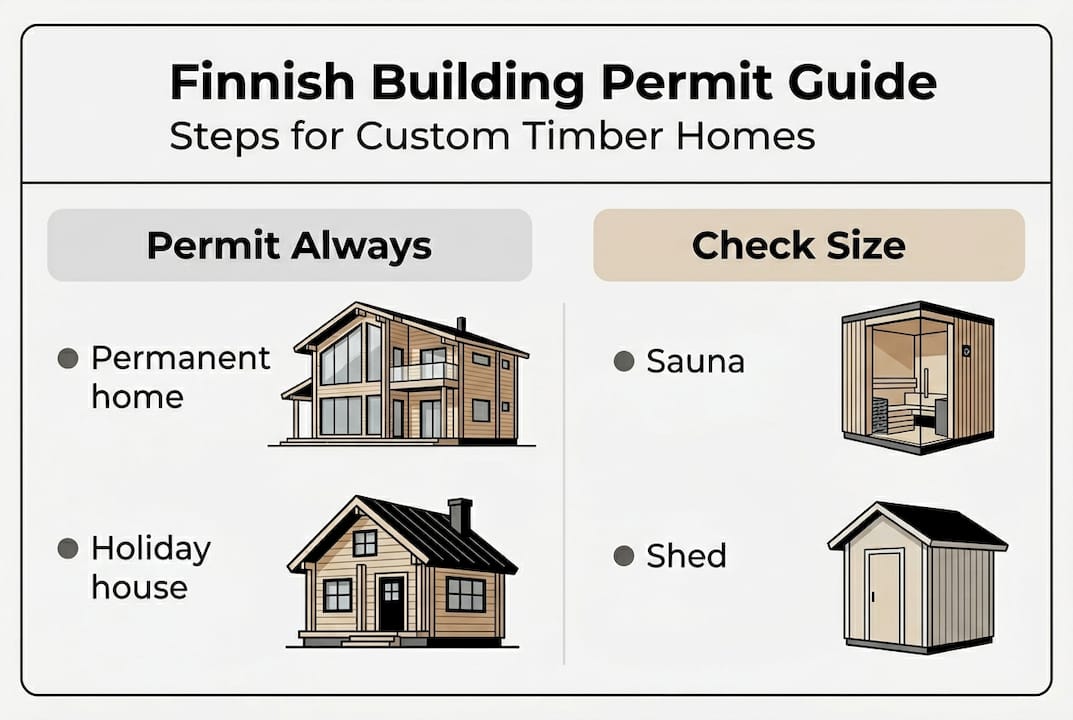
The rakentamislupa covers a wide scope. Any new permanent structure, major renovation, or change of use that affects a building’s structural integrity, fire safety, or energy performance typically falls under it. Residential buildings and holiday homes always require this permit, regardless of size. Auxiliary buildings like saunas and storage sheds have specific thresholds (more on those shortly).
Here’s a quick reference for which structures always require a permit:
| Structure type | Permit always required? |
|---|---|
| Permanent home (detached, semi) | Yes |
| Cottage or holiday home (loma-asunto) | Yes |
| Apartment building | Yes |
| Sauna with kitchen | Yes |
| Garage (attached to home) | Yes |
| Small storage shed under thresholds | Not always |
One of the most significant changes in the process is digital. Permit applications are now submitted exclusively through Lupapiste.fi, and BIM (Building Information Modeling) data is being integrated to speed up review. There’s no more dropping paper plans at a municipal office window.
For wooden structures specifically, the shift matters a lot. If you’re building a log home or a timber-frame cottage, check the full permit process guide before assuming your build is exempt. The planning permission for wooden houses varies slightly based on materials and location, so getting clarity early saves time.
The rakentamislupa requirements are publicly listed at the municipal level, and each municipality publishes its own instructions. What Sipoo requires may differ slightly from what Raakkyla or Tampere expects, even under the same national law.
Which structures need a permit—and which don’t?
Now that the overall permit system is clear, let’s break down what you must (and might not need to) apply for, based on your specific building project.
Rakentamislupa is always required for residential buildings and holiday homes, regardless of size. You cannot build a small summer cottage and skip the permit simply because it’s 40 square meters. If people sleep there, a permit is needed.
For non-residential auxiliary buildings, the thresholds matter. A standalone sauna without a kitchen requires a permit if its floor area is 30 m² or more, or its volume reaches 120 m³ or more. Below those numbers, you may only need to file a notification. But here’s the trap: adding a kitchen to a sauna instantly reclassifies it as a residential structure, triggering a full permit requirement regardless of size.
This classification issue catches many homeowners off guard. A sauna with a small kitchenette added for convenience is no longer just a sauna in the eyes of Finnish building law. It becomes a dwelling.
Here’s a comparison to keep your project on track:
| Structure | Permit required? | Threshold/notes |
|---|---|---|
| Detached home | Yes | Always |
| Summer cottage (loma-asunto) | Yes | Always |
| Sauna, no kitchen, under 30 m² | Not always | Notification may suffice |
| Sauna, no kitchen, 30 m²+ | Yes | Permit required |
| Sauna with any kitchen | Yes | Treated as residential |
| Small storage shed | Not always | Check local order |
| Greenhouse/carport | Varies | Check municipality |
When deciding whether to apply or just notify, follow this order:
- Check if your structure is residential or a holiday home. If yes, apply for a permit.
- Identify the floor area and volume of any auxiliary building.
- Confirm whether the structure includes any kitchen facilities.
- Review your municipality’s local building order (rakennusjärjestys) for any stricter local rules.
- Contact your municipal building office if any edge case applies.
Pro Tip: If you’re planning a cottage with an attached sauna, treat them as a combined project from the start. Separating them administratively is possible but adds work and can create inconsistencies in your documentation.
For more detail on thresholds and local variations, the permit breakdown chart provides a clear overview. You can also find specific guidance in our cottage building requirements and sauna permit guide.
What you need before applying: prerequisites and local rules
Once you know whether you need a permit, the next step is ensuring you have all prerequisites in place before starting your application.
Prerequisites include checking your local building order, zoning plan, plot rights, and engaging qualified designers. In some cases, you’ll also need to notify neighboring property owners before the municipality can process your application.
Here’s what to gather before you open a case on Lupapiste.fi:
- Zoning information: Confirm whether your plot is in a detailed plan area (asemakaava), general plan area, or unplanned rural land. Each carries different rules.
- Plot rights: You need to know your allowed building volume (often expressed as floor area ratio) before a designer can finalize plans.
- Qualified designers: Finnish law requires a pääsuunnittelija (lead designer) for most permitted projects. For timber homes, structural expertise is essential.
- Neighbor notifications: In many municipalities, you must inform adjacent landowners of your planned build before the authority can approve.
- Local building order: Even under the new unified system, municipalities issue their own rakennusjärjestys that can add stricter rules than national minimums.
Wooden structures require additional focus on fire safety certifications, thermal performance documentation, and qualified structural reports. Log and timber-frame homes have specific requirements around wall thickness, insulation values, and fire compartmentalization that a general contractor may not be familiar with.
“The biggest mistake we see is homeowners starting the design process without first checking their plot rights and zoning. You can design a beautiful home that simply doesn’t fit the allowed floor area. That’s an expensive revision to make after the fact.”
Pro Tip: Book a preliminary consultation (ennakkoneuvottelu) with your municipal building office before submitting anything. Most municipalities offer this service free of charge, and it can reveal requirements you’d never find by reading guidelines alone.
For a full breakdown of what Finnish law expects from timber builds, the timber building regulations page covers current requirements, and the homeowner’s construction checklist helps you stay organized across every stage.
How the permit application process works—step by step
Preparation complete, here’s how to navigate the digital application process and what to expect at every step.
Permit applications are submitted via Lupapiste.fi to local municipal authorities. The minimum required attachments include a site control statement and main plans or machine-readable BIM data. Processing times typically run between 3 and 6 months depending on the municipality and project complexity.
Here’s the process in order:
- Create an account on Lupapiste.fi and open a new permit case. Select your municipality and structure type.
- Attach your site control statement (showing you have rights to build on the plot).
- Upload architectural plans or BIM data, prepared by your qualified lead designer.
- Submit supplementary reports for fire safety and energy performance if required by your municipality or project type.
- Wait for neighbor notification completion if applicable—the municipality may handle this or require you to do it.
- Respond to any requests for clarification from the building authority during review.
- Receive the permit decision, then wait for the appeal period (usually 30 days) before starting work.
“Permit decisions are typically appealable for 30 days after publication. Starting work before this period ends carries legal risk, even if your permit looks approved.”
Permits are valid for 3 years to start construction and 5 years to complete the project, with extension options available upon request before the deadline. Missing those windows without an extension means the permit lapses. You would need to reapply, which restarts the entire process.
If the authority fails to process your application within the statutory timeframe, you may be entitled to a refund of part of the processing fee. It’s worth knowing, but don’t count on it as a strategy.
The consequences of skipping a required permit are serious. Non-compliance can trigger work stoppages, financial fines, or forced demolition. Our guide on how to avoid permit pitfalls covers the most common mistakes timber builders make, and the step-by-step permit instructions walks through each phase in more detail.
What most guides miss: local variation and wooden structure essentials
Most permit guides focus on national rules and stop there. That’s useful as a starting point, but it misses something important: municipalities retain significant flexibility.
The 2025 reform simplifies the system, but municipalities still maintain their own rakennusjärjestys, and digital tools like Lupapiste enhance efficiency without overriding local rules. A building that needs only a notification in one municipality might require a full permit in the next town over, based on nothing more than a stricter local building order.
For timber builds specifically, fire performance and thermal documentation are often where projects stall. Many designers are competent but not specialized in log or timber-frame construction. Selecting a designer with specific experience in wooden structures isn’t just a good idea—it often determines how smoothly your application moves through review.
Another overlooked point: permit-free doesn’t mean regulation-free. Even if your small shed or sauna clears the threshold for exemption, you still must respect setback distances from property lines, height restrictions, and material standards. Assuming otherwise has led more than a few homeowners to tear down a completed structure. Our outdoor sauna building tips address exactly these edge cases in practical terms.
Ready to build? Simplify your timber project with expert help
Navigating Finnish building permits is manageable once you understand the system, but every project has details that general guides can’t fully anticipate.
With over 65 years of experience manufacturing custom timber structures from Finnish wood, Huvila Seppälä has guided countless homeowners through exactly this process. Whether you’re planning a log cabin construction, exploring custom wooden villas, or working through your first cottage building guide, our team provides transparent quotes and project-specific advice with no hidden costs. Reach out through our contact form to get a personalized offer based on your own drawings and site conditions—and start your build on solid ground.
Frequently asked questions
Do I need a permit for a small wooden sauna in Finland?
You need a building permit for a sauna only if its floor area reaches 30 m² or its volume hits 120 m³. Adding a kitchen to any sauna, regardless of size, always requires a permit because it reclassifies the structure as residential.
What documents are required for a Finnish building permit application?
You’ll need a site control statement, main architectural plans or BIM data prepared by a qualified lead designer, and sometimes supplementary fire and energy performance reports. Mandatory attachments are minimal but must meet municipal standards.
How long is a building permit valid in Finland?
Permits are valid for 3 years to start construction and 5 years to complete the project, with extensions available if you apply before the deadline expires.
What happens if I build without the required permit?
Building without a required permit can result in work stoppages, financial fines, or forced demolition of the structure. The risks are significant and not worth the shortcut.
Does a permit exemption mean no rules apply?
No. Even permit-free builds must comply with zoning, setback distances, height limits, and safety regulations. Always confirm with your municipality early, since local building orders can add requirements beyond national minimums.
Recommended
- Building Permits Process Finland: Step-by-Step Guide – Hirsitalot, pihasaunat ja piharakennukset kotimaisesta hirrestä
- Building regulations in Finland 2026: timber guide – Hirsitalot, pihasaunat ja piharakennukset kotimaisesta hirrestä
- Finnish timber construction checklist: homeowner’s guide – Hirsitalot, pihasaunat ja piharakennukset kotimaisesta hirrestä
- Building Permits: Why They Matter for Timber Homes – Hirsitalot, pihasaunat ja piharakennukset kotimaisesta hirrestä