
Building regulations in Finland 2026: timber guide
Planning a timber or log building project in Finland requires navigating updated regulations that took effect in 2025. Many assume small structures skip permits entirely, but recent changes introduce specific thresholds and conditions that directly impact timber construction. Understanding when permits are mandatory, which exemptions apply, and how material standards affect your project ensures compliance and avoids costly delays. This guide clarifies the essential permit requirements, material regulations, and zoning considerations for timber and log builds, equipping you with practical knowledge to move forward confidently.
Table of Contents
- Understanding Building Permit Requirements In Finland For Timber Structures
- Standards And Regulations For Timber And Log Construction Materials
- Special Cases And Exemptions: Saunas, Outbuildings, And Canopies
- Navigating Zoning, Municipal Codes, And Environmental Considerations
- Explore Expert Timber Building Solutions With Huvilaseppala
- Frequently Asked Questions
Key takeaways
| Point | Details |
|---|---|
| Permit thresholds changed Jan 1, 2025 | Buildings under 30 m² and 120 m³ often exempt if zoning permits, but larger structures require permits. |
| Canopy exemptions depend on openness | Canopies under 50 m² with at least 30% open wall surface typically skip permits. |
| Saunas and outbuildings have clear rules | Structures under 30 m² serving the main building or functioning primarily as saunas generally avoid permit requirements. |
| Material standards ensure safety | SFS-EN 14080 governs glued laminated timber production, affecting structural quality and compliance. |
| Zoning and environmental permits matter | Local codes, landscape permits for tree removal, and wastewater system rules add layers of compliance beyond basic building permits. |
Understanding building permit requirements in Finland for timber structures
The Finnish Building Act effective Jan 1, 2025 introduced updated thresholds that reshape when permits are necessary for timber and log construction. Buildings measuring 30 m² or larger and exceeding 120 m³ in volume now trigger mandatory permit applications, assuming local zoning regulations allow construction in the first place. Smaller structures that stay below these limits often qualify for exemptions, but only when they align with detailed plan requirements or shoreline building rules.
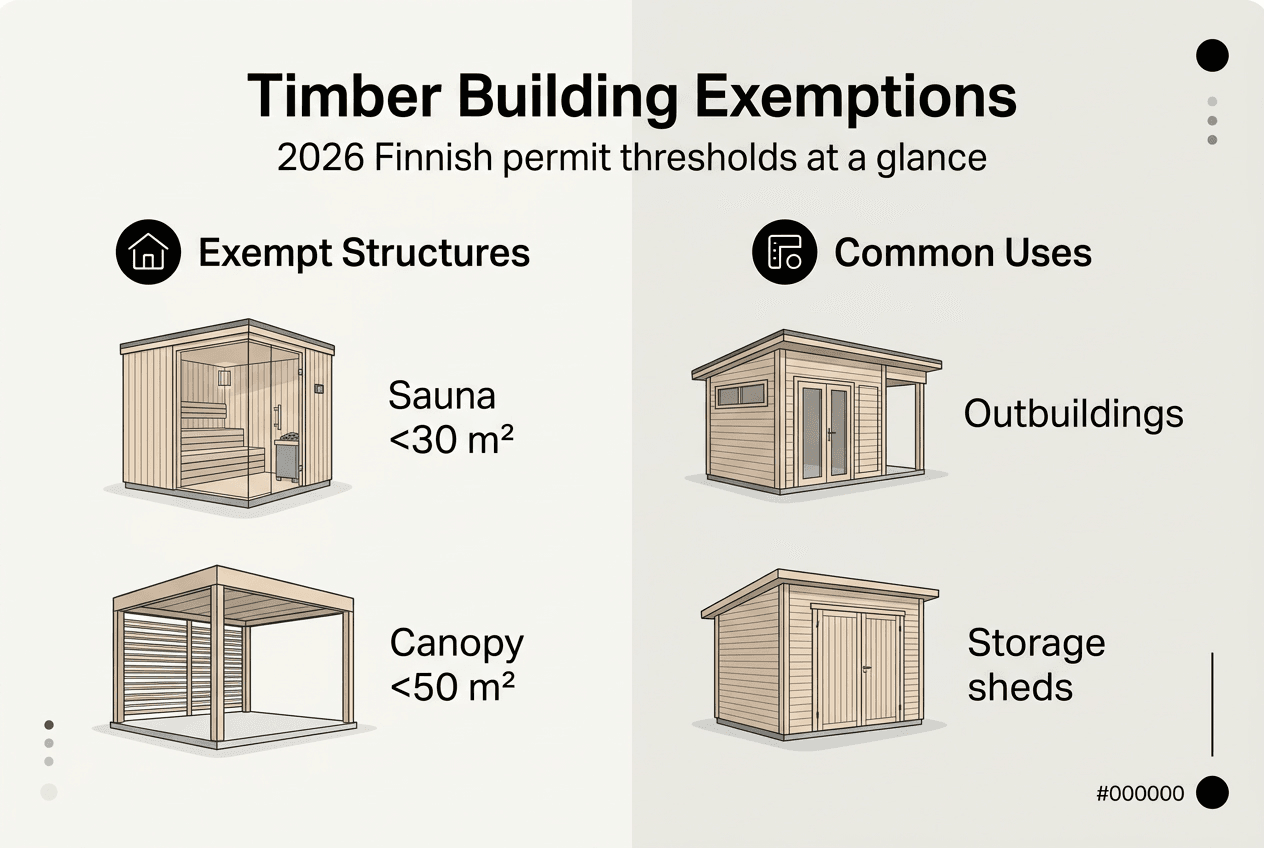
Canopies present a distinct scenario. Structures under 50 m² that maintain at least 30% open wall surface area typically bypass permit requirements, making them attractive for sheltered outdoor spaces or storage. However, exceeding the 50 m² threshold or enclosing walls beyond the 30% limit shifts the project into permit territory, regardless of material choice.
Saunas and outbuildings under 30 m² generally escape permit obligations, provided they serve the main building without residential use and meet functional definitions. A sauna must dedicate at least 50% of its floor area to sauna functions, ensuring it fits the exemption category. Outbuildings like tool sheds or storage spaces qualify when they support the primary structure without independent living quarters.
Certain building types always demand permits, regardless of size. Public-use structures, tall masts, and buildings in detailed plan areas with specific restrictions fall into this category. The building permits process in Finland involves submitting detailed plans, structural calculations, and compliance documentation to municipal authorities, who review projects against national and local standards.
Pro Tip: Confirm zoning status before designing your timber structure. Even exempt buildings must comply with setback distances, height limits, and land use designations to avoid permit complications later.
- Buildings under 30 m² and 120 m³ often skip permits if zoning allows.
- Canopies under 50 m² with 30%+ open walls typically qualify for exemptions.
- Saunas and outbuildings under 30 m² avoid permits when meeting functional definitions.
- Public-use structures and tall masts always require permits.
- Detailed plan areas may impose additional restrictions beyond size thresholds.
Statistic spotlight: Over 60% of small timber outbuildings in Finland now fall under the 30 m² exemption threshold, streamlining backyard construction for homeowners since the 2025 regulation update.
Standards and regulations for timber and log construction materials
Timber quality and production methods directly impact structural safety and regulatory compliance in Finnish construction. SFS-EN 14080 governs glued laminated timber, specifying minimum requirements for softwood and poplar products used in load-bearing applications. This standard defines lamella thickness, bonding procedures, and strength classifications that manufacturers must meet to sell timber products for building projects.

Glued laminated timber, commonly called glulam, consists of multiple wood layers bonded with adhesives to create beams and columns with superior strength and dimensional stability compared to solid timber. The standard addresses horizontal and vertical glulam types, each suited to different structural roles. Horizontal glulam features lamellae oriented perpendicular to the beam length, ideal for beams and headers. Vertical glulam aligns lamellae parallel to the length, commonly used in columns and posts.
Production requirements under SFS-EN 14080 ensure consistent quality across batches. Manufacturers must implement factory production control systems, conduct regular testing, and apply conformity marking to finished products. These measures verify that timber meets declared strength classes and moisture content limits, reducing failure risks in completed structures. For custom timber homes and log buildings, sourcing materials from compliant producers guarantees adherence to Finnish regulations.
Verifying timber product compliance involves checking conformity markings and requesting documentation from suppliers. Conformity marks display the manufacturer’s identification, product standard reference, strength class, and certification body details. Builders should confirm that suppliers provide test reports and factory production control certificates, especially for structural components like beams and trusses.
Pro Tip: Request conformity documentation before purchasing timber for structural applications. This proactive step prevents compliance issues during municipal inspections and ensures your project meets safety standards.
| Timber Type | Standard | Key Requirements | Typical Use |
|---|---|---|---|
| Horizontal Glulam | SFS-EN 14080 | Lamellae thickness 6-45 mm, strength class GL24-GL32 | Beams, headers, roof trusses |
| Vertical Glulam | SFS-EN 14080 | Lamellae thickness 6-45 mm, moisture content ≤15% | Columns, posts, wall studs |
| Solid Timber | SFS-EN 14081 | Strength grading, moisture limits, dimensional tolerances | Framing, joists, decking |
| Cross-Laminated Timber | SFS-EN 16351 | Layer orientation, bonding quality, fire resistance | Wall panels, floor slabs |
These timber construction standards apply universally across Finland, ensuring that log houses, timber frames, and hybrid structures meet baseline safety and durability expectations. Custom builds benefit from these regulations by standardizing material performance, simplifying design calculations, and providing clear benchmarks for quality assurance.
Special cases and exemptions: saunas, outbuildings, and canopies
Saunas occupy a unique position in Finnish building regulations, reflecting their cultural significance and widespread use. A structure qualifies as a sauna when at least 50% of its floor area serves sauna functions, including the sauna room, changing area, and related facilities. Saunas under 30 m² avoid building permits when they meet this functional definition and comply with local zoning codes.
Outbuildings serve the main building without providing independent residential use. Tool sheds, storage buildings, and garden structures fall into this category, provided they remain under 30 m² and support the primary structure’s functions. These buildings must respect setback distances from property lines and neighboring structures, even when permit exempt. Fire safety regulations require minimum distances between buildings, particularly in areas outside detailed plans.
Canopies offer weather protection while maintaining open sides, making them popular for outdoor seating, vehicle storage, and firewood shelters. The exemption for canopies under 50 m² hinges on maintaining at least 30% open wall surface area, calculated across all vertical surfaces. Enclosing sides with panels, screens, or walls beyond the 30% threshold converts the canopy into a building that requires a permit, regardless of its original design intent.
Expert planning reduces permit complications by addressing zoning requirements, setback distances, and functional definitions early in the design phase. Consulting with architects familiar with building codes for saunas and outbuildings ensures your project aligns with exemption criteria before construction begins. Municipal authorities can clarify site-specific restrictions, particularly in shoreline areas or detailed plan zones where additional rules apply.
Pro Tip: Photograph your site and mark proposed building locations before consulting municipal offices. Visual context helps authorities provide accurate guidance on setbacks, zoning compliance, and permit requirements.
- Saunas under 30 m² with 50%+ sauna function area skip permits.
- Outbuildings under 30 m² serving the main structure avoid permit requirements.
- Canopies under 50 m² need 30%+ open wall area for exemptions.
- Fire safety rules mandate minimum distances between buildings.
- Detailed plan areas may impose stricter placement and design rules.
The sauna building permit process becomes necessary when structures exceed size limits, serve residential purposes, or fail to meet functional definitions. Understanding these boundaries helps homeowners design projects that stay within exemption parameters while meeting practical needs.
Navigating zoning, municipal codes, and environmental considerations
Zoning laws dictate where buildings can be placed, how large they can be, and what activities they can support. Detailed plan areas feature specific regulations covering building height, floor area ratios, setback distances, and architectural styles. These plans aim to maintain neighborhood character and ensure orderly development, but they also restrict design flexibility compared to areas without detailed plans.
Outside detailed plan areas, shoreline building regulations and general zoning rules govern construction. Shoreline zones typically limit building sizes, require greater setbacks from water bodies, and restrict activities to preserve natural landscapes. Landscape permits may be required for tree removal in detailed plan areas, adding another layer of approval before construction begins. Removing trees without authorization can result in fines and project delays, making early consultation with municipal authorities essential.
Wastewater systems always require building permits, regardless of building size or exemption status. Installing septic tanks, drainage fields, or composting toilets involves environmental considerations that municipalities regulate to protect groundwater and surface water quality. Permit applications for wastewater systems must include site assessments, soil percolation tests, and system design plans prepared by qualified professionals.
Fire regulations influence building placement and construction methods, particularly outside detailed plan areas. Minimum distances between buildings prevent fire spread and ensure emergency access. Timber and log structures must meet fire resistance requirements based on building size, occupancy type, and proximity to other structures. Using fire-retardant treatments or designing with fire-resistant materials helps satisfy these regulations.
Comparing zoning rules inside and outside detailed plan areas reveals significant differences:
- Detailed plan areas enforce specific building heights, often limiting structures to one or two stories.
- Outside detailed plans, general height limits apply, but design flexibility increases.
- Setback distances from property lines are stricter in detailed plan areas, reducing buildable space.
- Architectural style guidelines in detailed plans may require approval for exterior materials and colors.
- Shoreline areas outside detailed plans impose distance requirements from water bodies, typically 100-200 meters.
- Tree removal in detailed plan areas often requires landscape permits, while outside areas have fewer restrictions.
| Zoning Type | Height Limits | Setback Distances | Tree Removal | Design Flexibility |
|---|---|---|---|---|
| Detailed Plan Area | Specified in plan (often 1-2 stories) | Strict, defined by plan | Landscape permit often required | Low, must follow plan guidelines |
| Outside Detailed Plan | General limits apply (varies by municipality) | Moderate, based on general rules | Fewer restrictions, case-by-case | High, more design freedom |
| Shoreline Zone | Restricted, lower than inland areas | Large setbacks from water (100-200 m) | Protected, permits often needed | Moderate, environmental focus |
The building permits process in Finland requires coordination with municipal building control offices, environmental authorities, and sometimes regional councils. Starting this process early, ideally during the design phase, prevents surprises and ensures your timber or log project proceeds smoothly through approvals.
Explore expert timber building solutions with Huvilaseppala
Navigating Finnish building regulations demands expertise, especially for custom timber and log projects where material standards, zoning rules, and permit requirements intersect. Huvilaseppala brings over 65 years of experience manufacturing timber frames and log structures, offering tailored solutions that align with regulatory expectations while delivering authentic Finnish craftsmanship.
From initial planning to final construction, Huvilaseppala guides you through financing options, architectural design, and compliance with Finnish standards. Their team understands the nuances of why building with timber offers both environmental and structural advantages, and they translate that knowledge into projects that meet your vision and regulatory requirements. Whether you are constructing a sauna, cottage, or villa, their step by step cottage building guide simplifies the process, ensuring every phase proceeds efficiently. Explore financing options for timber buildings to make your project financially viable while maintaining quality and compliance.
Frequently asked questions
What size buildings require a permit in Finland?
Buildings measuring 30 m² or larger and exceeding 120 m³ in volume typically require permits under the 2025 Finnish Building Act. Smaller structures may qualify for exemptions if local zoning regulations permit construction and the building meets functional definitions. Canopies over 50 m² also need permits unless they maintain at least 30% open wall surface area.
Are permits needed for building a sauna on my property?
Saunas under 30 m² with at least 50% of floor area dedicated to sauna functions generally do not require permits, provided they comply with local codes. Larger saunas or those serving residential purposes beyond traditional sauna use may trigger permit requirements. Always verify with municipal authorities, as building codes for saunas can vary by location and site conditions.
What environmental permits may impact timber building projects?
Landscape permits are often required for tree removal in detailed plan areas, protecting green spaces and maintaining neighborhood character. Building a wastewater system, regardless of building size, always requires a permit to ensure environmental protection and water quality. Environmental rules vary by municipality, so consulting local authorities early prevents delays and ensures compliance with all applicable regulations.
How can I ensure my timber construction complies with Finnish regulations?
Engage qualified planners and architects familiar with Finnish building standards, including SFS-EN 14080 for glued laminated timber and local zoning codes. Coordinate with municipal authorities during the design phase to clarify permit requirements, setback distances, and material specifications. Use professional builders experienced in timber construction, and follow the building permits process in Finland to navigate approvals efficiently and avoid costly mistakes.
Recommended
- Timber Home Terminology Finland 2026: 20% Better Insulation – Hirsitalot, pihasaunat ja piharakennukset kotimaisesta hirrestä
- Guide to choosing Finnish wood for sustainable homes 2026 – Hirsitalot, pihasaunat ja piharakennukset kotimaisesta hirrestä
- Build your Finnish outdoor sauna step by step in 2026 – Hirsitalot, pihasaunat ja piharakennukset kotimaisesta hirrestä
- Building Permits Process Finland: Step-by-Step Guide – Hirsitalot, pihasaunat ja piharakennukset kotimaisesta hirrestä