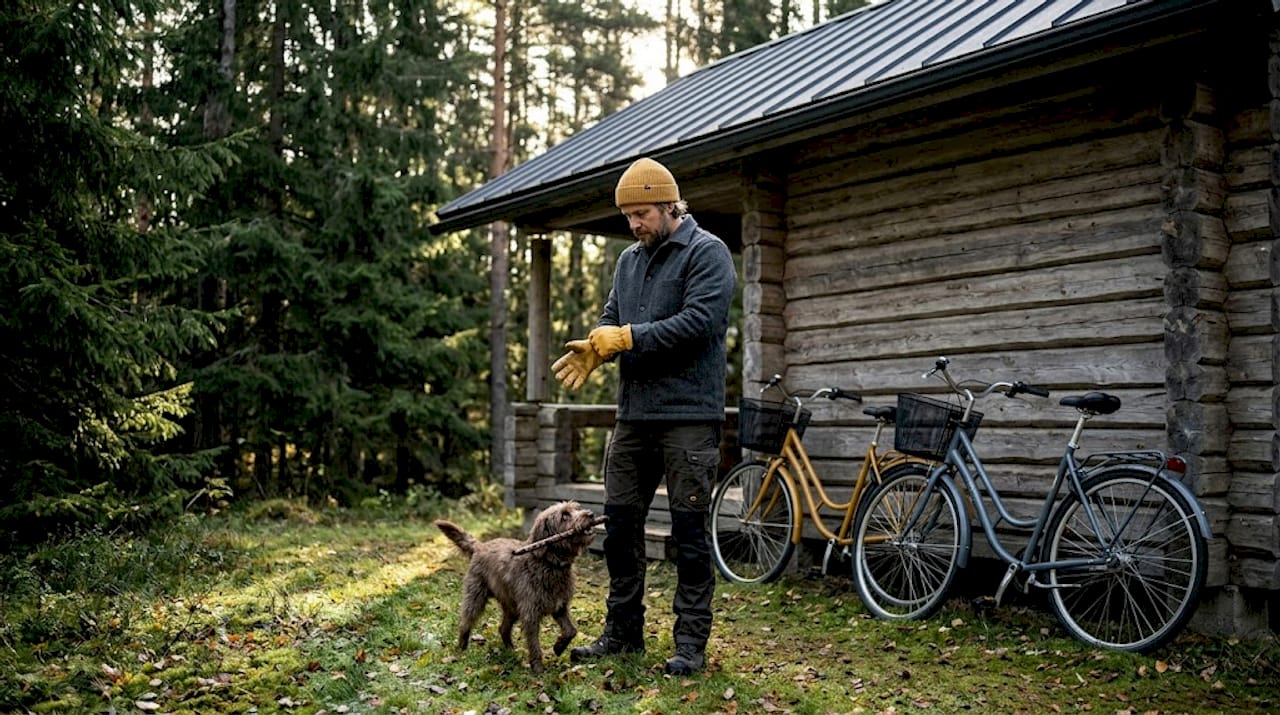
Sustainable log construction: key principles for Finnish homes
TL;DR:
- Sustainable log construction requires responsible sourcing, design, and life-cycle analysis.
- Whole-life carbon accounting, including embodied and operational emissions, is essential for true sustainability.
- Selecting certified, locally sourced timber and designing for longevity help ensure environmentally responsible builds.
Building with wood sounds inherently green. Finnish forests cover roughly 75% of the country’s land area, and log homes have been part of the cultural landscape for centuries. But assuming that any log construction is automatically sustainable is a mistake that can lead homeowners toward choices that look eco-friendly on the surface while missing the mark in practice. True sustainability in log construction depends on sourcing, design, life-cycle thinking, and honest trade-off analysis. This guide walks you through what that actually means before you break ground.
Table of Contents
- Defining sustainable log construction
- Key principles: from forest to finished home
- Material impacts: life-cycle and carbon
- Limitations and trade-offs: not all log construction is equally sustainable
- How to ensure your Finnish log home is truly sustainable
- The uncomfortable truth about sustainable log construction
- Explore sustainable log solutions built for Finland
- Frequently asked questions
Key Takeaways
| Point | Details |
|---|---|
| Sustainability is nuanced | Building with logs only counts as sustainable when forests are responsibly managed and life-cycle carbon is minimized. |
| Evaluate whole-life impact | Successful sustainable log homes focus on both embodied and operational carbon—ask for benchmarks and documentation. |
| Consider ecological limits | More wood use is not always better—protecting forests requires balancing supply, competing timber uses, and demand. |
| Practical choices matter | Selecting certified local wood, transparent contractors, and efficient designs is key for homeowners aiming for true sustainability. |
Defining sustainable log construction
The word “sustainable” gets used loosely in construction marketing. A wooden wall is not automatically sustainable just because trees are renewable. Real sustainability in log construction involves a set of measurable criteria that go well beyond material choice.
The most important shift in how the industry now evaluates buildings is the move toward whole-life carbon accounting. This means measuring both embodied carbon (the emissions locked into producing, transporting, and assembling your materials) and operational carbon (the energy your home uses over its lifetime). Research on timber and climate impacts shows that both sides of this equation matter enormously. A log home built from poorly sourced timber with a leaky thermal envelope can easily outperform its carbon budget within a decade, regardless of how “natural” it looks.
Whole-life carbon studies now set the standard: sustainability criteria must include both embodied and operational carbon, and guidance documents are beginning to set hard numerical targets for low-carbon buildings. This is a meaningful shift. It means your builder should be able to speak to both numbers, not just hand you a brochure about Finnish forests.
Here is what a genuinely sustainable log construction project includes:
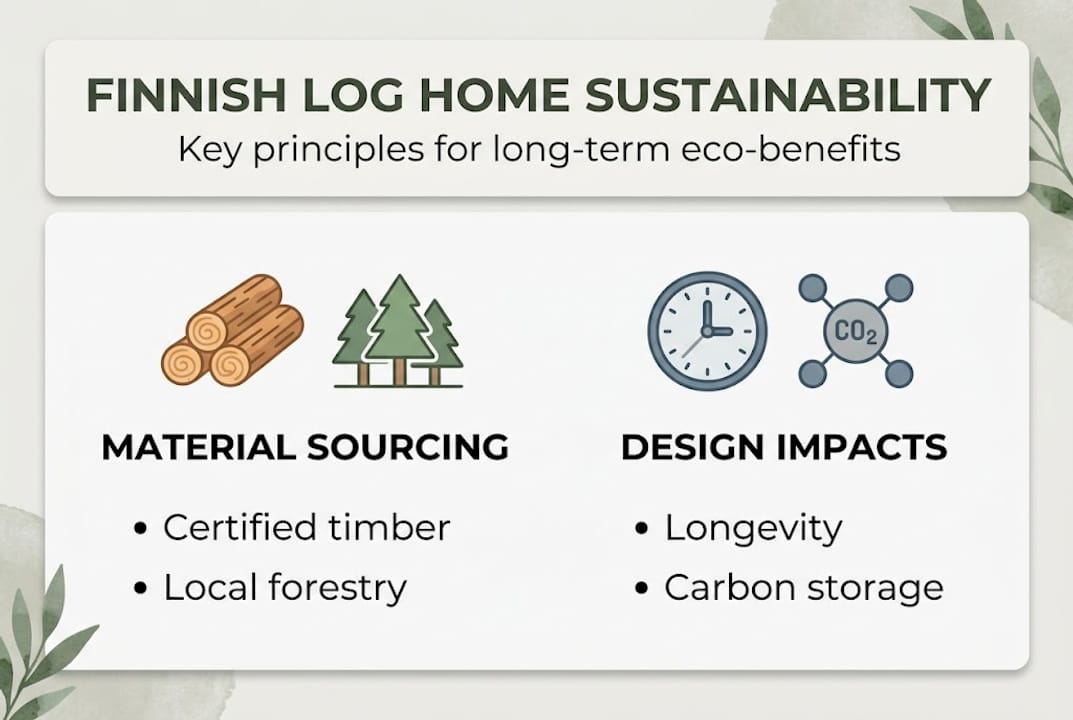
- Responsibly sourced timber from certified, well-managed forests
- Low embodied carbon from local material supply chains
- High operational energy performance through good insulation and airtight detailing
- Ecological integrity in the forests supplying the wood
- Documented chain of custody from forest to finished frame
“Sustainability in wood construction is not a single property of the material. It is a relationship between the forest, the supply chain, the building design, and the way the home is used over its lifetime.”
Exploring Finnish eco-friendly timber options is a good starting point, but it is only one piece of the picture.
Key principles: from forest to finished home
Understanding the definition is useful. Putting it into practice requires following a clear chain of decisions from the forest all the way to your front door.
Here are the core principles in order:
-
Start with forest management. The sustainability of your log home begins before a single tree is felled. Forests managed for biodiversity, long rotation cycles, and soil health produce timber that carries a genuinely low ecological footprint. Finnish forestry has a strong track record here, but not all suppliers operate to the same standard. Ask specifically about the forest management practices behind the timber you are buying.
-
Verify chain of custody. Responsible sourcing does not stop at the forest gate. Every step between the tree and your wall panel needs to be traceable. FSC (Forest Stewardship Council) and PEFC (Programme for the Endorsement of Forest Certification) certifications are the most widely recognized standards. They are not perfect, but they provide a documented baseline.
-
Prioritize local and appropriate species. Finnish Scots pine and Norway spruce are well suited to log construction in this climate. They grow locally, require shorter transport distances, and perform well in cold, humid conditions. Importing exotic species for aesthetic reasons adds unnecessary carbon to your project without functional benefit.
-
Understand supply and demand context. This is where many homeowners stop thinking. Academic research shows that the sustainability of increased wood use in construction has real ecological limits, and that supply and demand dynamics matter as much as individual sourcing decisions. If demand for construction timber grows faster than forests can responsibly supply it, the whole system comes under pressure.
-
Design for longevity. A log home that lasts 100 years distributes its embodied carbon over a much longer period than one that needs major renovation every 20 years. Design decisions made at the planning stage, including roof overhangs, foundation drainage, and log species selection, directly affect how long your home performs well.
Pro Tip: When you contact a timber supplier, ask them for their sustainability documentation before discussing price. A supplier who cannot produce chain-of-custody certification or forest management credentials is a red flag, regardless of how competitive their quote looks.
Using Finnish forestry as your supply base is a strong starting point, but it works best when paired with choosing Finnish wood species and dimensions suited to your specific project.
Material impacts: life-cycle and carbon
Once you understand sourcing, the next question is how sustainable log construction actually performs over the full life of your home. The numbers here are more encouraging than many people expect, but they come with important conditions.
Timber buildings consistently outperform concrete and steel structures on embodied carbon. Wood stores carbon absorbed during the tree’s growth, so a log wall acts as a carbon sink for the building’s lifetime. But the full picture requires looking at the whole life cycle.
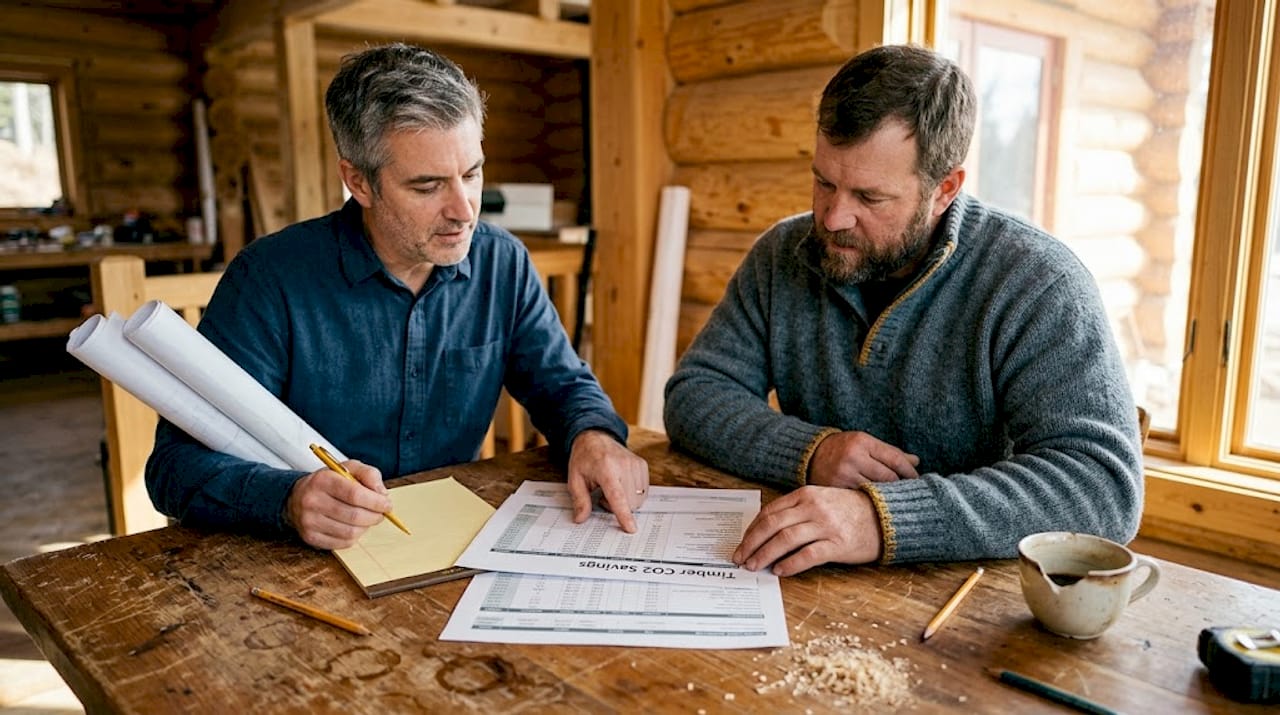
| Building type | Typical whole-life carbon | Notes |
|---|---|---|
| Concrete frame residential | 25 to 35 kg CO2e/m2/year | High embodied carbon from cement |
| Steel frame residential | 20 to 30 kg CO2e/m2/year | Energy-intensive production |
| Timber frame residential | 10 to 18 kg CO2e/m2/year | Varies by insulation and sourcing |
| Well-designed log home | 8 to 14 kg CO2e/m2/year | Best case with local timber and good design |
Research across 45 timber buildings shows that material-related impacts are now a prime reporting focus, with some guidance documents setting targets as low as 12 kg CO2e/m2/year for low-carbon buildings. That is achievable for a well-designed Finnish log home, but it requires intentional decisions at every stage, not just a preference for wood.
What drives carbon performance in log homes:
- Log wall thickness and thermal mass affect heating energy demand directly
- Foundation type (insulated slab vs. crawl space) has a significant impact on heat loss
- Heating system choice (heat pump, district heating, biomass) determines operational carbon
- Material finishing choices (paints, sealants, adhesives) add small but real embodied carbon contributions
Pro Tip: Ask your designer to model the whole-life carbon of your proposed home before finalizing the specification. This is increasingly standard practice in professional Finnish construction, and it gives you a real benchmark to compare against.
Pairing good material choices with energy efficiency strategies for log homes is where the biggest carbon savings are found in practice.
Limitations and trade-offs: not all log construction is equally sustainable
It would be easy to read the previous sections and conclude that building a log home is always the right environmental choice. That conclusion would be too simple.
Academic research is clear that scaling up construction timber use must remain within forest-integrity and sustainability constraints, and that feasibility depends on supply and demand dynamics as well as trade-offs with other timber uses. In plain terms: if everyone builds a log home at once, the system breaks.
Here is a comparison of common trade-off scenarios Finnish homeowners should understand:
| Scenario | Sustainable outcome | Risk |
|---|---|---|
| Local certified timber, short supply chain | High | Low if demand stays balanced |
| Imported timber, uncertified | Low | High embodied carbon, unknown forest impact |
| High construction timber demand, low forest growth | Problematic | Pressure on forest health and biodiversity |
| Timber diverted from energy or paper use | Neutral to negative | Competing uses may have higher climate value |
The trade-off with competing timber uses is real. Finnish forests supply wood for energy production, paper, and construction. When construction demand rises sharply, it can pull timber away from other uses or push harvesting beyond ecologically sound limits. This does not mean you should not build a log home. It means you should build one that is designed to last, sourced from well-managed forests, and sized appropriately for your actual needs.
- Avoid oversizing your log home purely for status or resale speculation
- Choose suppliers with documented forest management plans
- Ask whether the timber comes from thinning operations (which improve forest health) or clear-cutting
- Prefer suppliers who can demonstrate that their harvest rates stay within sustainable yield limits
“The question is not whether wood is good. The question is whether this wood, from this forest, at this volume, at this time, is the right choice.”
Exploring Finnish timber sustainability in more depth will help you ask the right questions of any supplier you consider.
How to ensure your Finnish log home is truly sustainable
Knowing the principles is one thing. Applying them to your actual project is where most homeowners need practical guidance.
Here is a step-by-step approach:
-
Request sustainability documentation upfront. Before signing any contract, ask your supplier and contractor for forest certification records, chain-of-custody documentation, and any available whole-life carbon assessments. Sustainability criteria now include material performance and carbon targets, so reputable builders will have this information ready.
-
Involve an architect with sustainability experience. The design stage is where the most significant sustainability decisions are made. Roof geometry, window placement, wall thickness, and foundation type all have major impacts on energy performance and longevity. Architecture shapes sustainable log homes more than most homeowners realize, and getting this right from the start is far cheaper than retrofitting later.
-
Specify your sustainability requirements in writing. Include requirements for certified timber, local sourcing preferences, and carbon performance targets in your project brief. This creates accountability and gives you a basis for comparison when evaluating quotes.
-
Ask specific questions during the design process. Good questions include: What certification does the timber carry? Where does the wood come from? What is the estimated whole-life carbon for this design? How long is this structure expected to last without major intervention?
-
Review the log home construction process in detail with your contractor so you understand every material input and can flag any substitutions that might compromise your sustainability goals.
-
Plan for end of life. A truly sustainable log home is designed so that its materials can be reused or recycled. Ask your designer how the structure would be dismantled at the end of its life, and whether the timber could be repurposed rather than sent to landfill or incineration.
Pro Tip: The most sustainable log home is one you will live in for decades. Prioritize durability, adaptability, and quality over short-term cost savings. A home that lasts 80 years with minimal maintenance has a dramatically better carbon profile than one that needs major repairs every 15 years.
The uncomfortable truth about sustainable log construction
Here is something the industry rarely says directly: most log homes marketed as sustainable are not evaluated against any meaningful standard. The word “sustainable” appears in brochures because it sells, not because the builder has modeled whole-life carbon or verified their supply chain beyond the first tier.
In Finland, there is a specific cultural risk. The long tradition of log building creates an assumption that heritage equals sustainability. It does not. A log home built in 2026 from poorly managed timber, with inadequate insulation and a fossil fuel heating system, is not sustainable just because Finnish people have been building with wood for a thousand years. Tradition is a valuable starting point, not a guarantee.
What Finnish homeowners should demand in 2026 is documentation. Not stories about forests. Not marketing language about natural materials. Actual numbers: embodied carbon per square meter, forest certification details, energy performance calculations, and a realistic assessment of how long the structure will last.
The good news is that Finland has the knowledge, the forestry infrastructure, and the building tradition to produce genuinely sustainable log homes. The climate impact realities of wood construction are genuinely favorable when the full system is managed well. But that requires homeowners who ask hard questions and builders who can answer them. The gap between a greenwashed log home and a genuinely sustainable one is not about the material. It is about the decisions made at every step of the process.
Explore sustainable log solutions built for Finland
If this guide has made you think more carefully about what sustainable log construction really involves, the next step is finding partners who can back up their claims with documentation and experience.
At Huvila Seppälä, we have spent over 65 years manufacturing custom log structures from Finnish wood, and we understand that sustainability is built into every decision from forest sourcing to final delivery. Whether you are planning a family home, a lakeside cottage, or a sauna, our team works from your own drawings to create structures that are built to last. Explore what eco-friendly timber building looks like in practice, browse our range of custom wooden villas, or follow our custom timber cottage guide to understand the full planning and building process. We provide transparent quotes with no hidden costs and fast delivery across Finland.
Frequently asked questions
Is log construction always the most sustainable building method in Finland?
No. Log construction’s sustainability depends on responsible forest sourcing, efficient design, and real supply management. Ecological limits mean that using more wood does not automatically produce better environmental outcomes.
What carbon targets should I look for with a sustainable log home?
Look for builders who aim for whole-life carbon benchmarks such as less than 12 kg CO2e/m2/year and who can provide documentation to support that figure.
Can I ensure my cottage or sauna project won’t harm local forests?
Yes. Work with suppliers using certified forestry, local materials, and transparent supply chains. Responsible supply management and forest integrity safeguards are the key requirements to verify.
Does increased use of Finnish timber risk depleting forests?
It can, if not balanced with ecological limits and other wood uses. Scaling timber demand can be constrained by forest integrity and trade-offs with energy and paper production, so careful management is essential.
Is certified wood enough to guarantee sustainable log construction?
Certification is essential but not sufficient. The entire supply chain and building design must also meet sustainability standards, including whole-life carbon performance and long-term durability.
Recommended
- How architecture shapes sustainable log homes in Finland – Hirsitalot, pihasaunat ja piharakennukset kotimaisesta hirrestä
- Log house architecture basics: build durable Finnish homes – Hirsitalot, pihasaunat ja piharakennukset kotimaisesta hirrestä
- Finnish log construction: tradition, precision, and custom homes – Hirsitalot, pihasaunat ja piharakennukset kotimaisesta hirrestä
- Boost energy efficiency in log homes: proven strategies – Hirsitalot, pihasaunat ja piharakennukset kotimaisesta hirrestä