Sustainability of Finnish wood: eco-friendly timber homes
You’ve probably heard that wood is a natural, renewable building material, but maybe you’ve wondered whether cutting down trees for your home or sauna is truly sustainable. The reality might surprise you: Finnish wood is sourced from sustainably managed forests, with 93-94% certified under PEFC and FSC systems ensuring biodiversity, traceability, and regeneration. For homeowners and builders in Finland, this means you can create beautiful, customizable wooden structures while actively supporting responsible forestry and reducing your carbon footprint. This guide will walk you through the environmental credentials of Finnish wood, compare its climate impact against conventional materials, and show you how to select the best timber for your home or sauna project.
Table of Contents
- Key takeaways
- Understanding the sustainability of Finnish wood
- The carbon footprint advantage of Finnish wood buildings
- Nuances and challenges in assessing wood sustainability
- Selecting and applying Finnish wood for sustainable homes and saunas
- Explore sustainable timber building solutions with HuvilaSeppälä
- Frequently asked questions
Key Takeaways
| Point | Details |
|---|---|
| Forest certification | Finnish wood comes from PEFC and FSC certified forests with full traceability from forest to finished product. |
| Low carbon footprint | Wood buildings in Finland have smaller embodied carbon and can act as carbon sinks over time compared with concrete. |
| Sustainable forestry balance | Sustainable forestry requires balancing harvest with regeneration to keep forests as carbon sinks and biodiversity intact. |
| Knot free heat treated wood | Knot free heat treated wood is recommended for durable and safe sauna construction. |
| Wood recycling limits | Recycling wood remains low and regional emissions vary by province affecting net benefits. |
Understanding the sustainability of Finnish wood
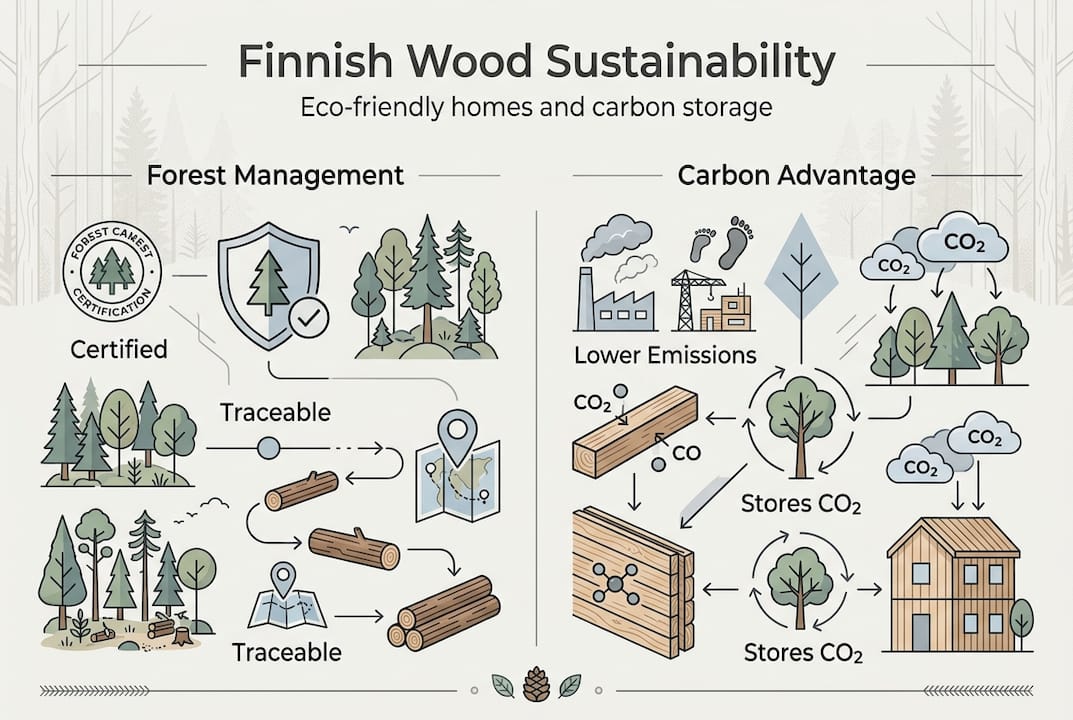
When you choose Finnish wood for your building project, you’re tapping into one of the world’s most rigorously managed forest systems. The Programme for the Endorsement of Forest Certification (PEFC) and Forest Stewardship Council (FSC) certifications aren’t just labels. They represent comprehensive frameworks that monitor harvest rates, protect wildlife habitats, and ensure forests regenerate faster than they’re cut. These systems track every log from forest to finished product, giving you complete transparency about where your timber originates.
Certified Finnish forestry for log homes follows strict guidelines that maintain biodiversity. Forest managers must preserve buffer zones around waterways, protect endangered species habitats, and maintain mixed age stands to support complex ecosystems. This approach contrasts sharply with industrial clear cutting practices seen in other regions. You’re not just buying wood; you’re supporting a forest management philosophy that views trees as part of living ecosystems rather than simple commodities.
Traceability systems embedded in certification processes mean every board in your sauna or home can be traced back to its origin forest. This chain of custody verification prevents illegal logging and ensures your project uses only legally harvested, sustainably sourced timber. For builders committed to environmental responsibility, this documentation provides concrete proof of sustainable practices.
However, sustainability isn’t without complexity. Balancing timber harvest with maintaining forests as carbon sinks requires constant monitoring and adjustment. Some environmental experts argue that even certified forests face pressure from increased harvest rates driven by growing demand for wood products. The key lies in ensuring regeneration outpaces removal, a balance Finnish forestry has maintained for decades.
Pro Tip: When sourcing wood for your project, request certification documentation from suppliers. Verified PEFC or FSC labels guarantee your timber meets international sustainability standards and supports responsible forest management.
Key certification benefits:
- Biodiversity protection through habitat preservation requirements
- Mandatory forest regeneration exceeding harvest volumes
- Complete supply chain traceability from forest to construction site
- Regular third party audits ensuring compliance with environmental standards
- Support for local forest communities and traditional practices
The carbon footprint advantage of Finnish wood buildings
Understanding Global Warming Potential (GWP) and embodied carbon helps you grasp why wood outperforms conventional materials. GWP measures total greenhouse gas emissions throughout a material’s lifecycle, from extraction through manufacturing to end of life disposal. Embodied carbon specifically refers to CO2 released during production, transportation, and installation. Log homes from Finnish wood have the smallest carbon footprints and act as carbon sinks long term.
Wood’s renewable nature gives it an inherent advantage. Trees absorb CO2 as they grow, storing carbon in their fibers. When you build with timber, that carbon remains locked in your walls, floors, and roof for the structure’s entire lifespan, often 50 to 100 years or more. This carbon storage effect means wooden buildings function as carbon sinks, actively removing CO2 from the atmosphere. Concrete and steel, by contrast, release massive amounts of carbon during production with no offsetting storage benefit.
LCA studies show wood buildings have 25-30% lower embodied carbon than concrete, up to 70% in floors. These reductions stem from wood’s low energy production requirements. Processing logs into construction lumber requires far less energy than heating limestone to 1450°C for cement or smelting iron ore for steel. Finnish mills often use wood waste and bark as fuel, creating nearly carbon neutral production cycles.
| Building Component | Wood GWP (kg CO2e/m²) | Concrete GWP (kg CO2e/m²) | Reduction |
|---|---|---|---|
| Structural walls | 45-60 | 85-110 | 35-45% |
| Floor systems (Kerto LVL) | 25-35 | 95-120 | 65-70% |
| Roof structures | 30-40 | 70-90 | 40-55% |
| Overall building envelope | 100-135 | 250-320 | 45-60% |
These numbers translate to real world impact. A typical 150 square meter Finnish log home stores approximately 20-25 tons of CO2 in its timber structure, equivalent to removing 4-5 cars from the road for a year. The benefits of log homes extend beyond carbon storage to include superior thermal performance and indoor air quality.
Finland’s low carbon electricity grid further enhances wood’s sustainability profile. Mills powered by hydroelectric or wind energy produce timber with minimal indirect emissions. This advantage compounds when you consider transportation distances. Sourcing local Finnish wood for your project eliminates the carbon intensive shipping required for imported materials.
Pro Tip: Use lifecycle assessment (LCA) tools specific to your building site and design. Regional factors like energy sources, transportation distances, and local climate significantly affect total carbon footprints. Online calculators from Finnish building research institutes can provide customized estimates for your project.
Nuances and challenges in assessing wood sustainability
Land Use, Land Use Change and Forestry (LULUC) emissions add complexity to wood sustainability calculations. LULUC accounts for carbon released when forests transition from carbon sinks to carbon sources during harvest periods. Even sustainably managed forests experience temporary carbon debt as trees are cut and soil is disturbed. The critical question becomes whether regrowth compensates for these emissions over reasonable timeframes.
Finnish forests’ carbon sink decreases due to LULUC emissions varying by province; net negative GWP occurs only in about half. Southern Finnish provinces with intensive forestry show higher LULUC emissions than northern regions with slower harvest cycles. This geographic variation means your timber’s true carbon impact depends partly on its origin location within Finland. Builders committed to minimizing climate impact should prioritize wood from provinces maintaining strong carbon sink performance.
Recycling presents another sustainability challenge. Wood recycling rates remain low; misfit wood faces profitability hurdles despite biodiversity benefits. Most construction wood waste currently goes to energy recovery, essentially incineration for heat or electricity. While energy recovery prevents landfill methane emissions, it releases stored carbon immediately rather than extending the material’s useful life through reuse or remanufacturing.
Economic factors drive low recycling rates. Sorting, cleaning, and reprocessing used timber costs more than harvesting fresh logs in many cases. Contamination from paints, preservatives, and fasteners complicates recycling further. Without policy interventions or market innovations making recycled wood economically competitive, most timber remains single use despite its technical recyclability.
Factors complicating wood sustainability assessments:
- Provincial differences in forest management intensity affecting LULUC emissions
- Temporary carbon debt during harvest and regrowth cycles
- Limited infrastructure for wood recycling and reuse
- Economic barriers to repurposing construction timber
- Variability in end of life scenarios from decades long storage to immediate combustion
These challenges don’t negate wood’s overall sustainability advantages, but they demand honest acknowledgment. You can make more informed decisions by considering local emissions data, prioritizing long lived building designs that maximize carbon storage duration, and supporting policy changes that improve wood recycling infrastructure. The wood construction climate impacts remain favorable compared to alternatives when you account for the full picture.
Selecting and applying Finnish wood for sustainable homes and saunas
Choosing the right wood species and specifications ensures your project delivers both sustainability and performance. For structural applications in homes and cottages, Finnish spruce and pine offer excellent strength to weight ratios, natural decay resistance, and beautiful grain patterns. These softwoods grow abundantly in Finnish forests and process efficiently into dimensional lumber, logs, and engineered products like cross laminated timber (CLT).
Sauna construction demands more specialized material choices. For saunas, use knot-free, resin-free heat-treated aspen, alder, or laminated spruce logs ≥68mm for durability and safety. Knots create weak points that can crack under thermal stress, while resin pockets can weep hot, sticky sap that burns skin. Heat treatment modifies wood’s cellular structure, improving dimensional stability and resistance to moisture damage without chemical preservatives.
Finnish building standards mandate minimum log thickness of 68mm for sauna walls, though 90mm or thicker performs better. Thick logs provide natural insulation and prevent warping, burns, and decay in high heat and humidity environments. Laminated logs, constructed from multiple thin boards glued together, offer superior stability compared to solid logs that can twist or check as moisture content fluctuates.
Steps for selecting optimal Finnish wood:
- Verify PEFC or FSC certification documentation from your supplier
- Match wood species to application: spruce/pine for structures, aspen/alder for sauna interiors
- Specify heat treatment for any wood exposed to high moisture or temperature extremes
- Choose appropriate dimensions: ≥68mm for saunas, standard framing sizes for homes
- Request kiln dried lumber with 12-15% moisture content for dimensional stability
- Inspect for defects: avoid excessive knots, splits, or insect damage
- Plan for natural wood movement with proper joinery and fastening techniques
Design considerations extend beyond material selection. Proper ventilation prevents moisture accumulation that accelerates decay. Roof overhangs protect walls from direct rain exposure. Elevated foundations prevent ground moisture wicking into timber. These design elements work synergistically with quality wood to create structures lasting generations.
The role of wood in sauna building encompasses thermal mass, moisture buffering, and aromatic benefits that synthetic materials cannot replicate. Wood’s cellular structure absorbs and releases moisture gradually, moderating humidity swings that would feel uncomfortable in tile or concrete saunas. Natural wood aromatics enhance the sensory experience without artificial fragrances.
Pro Tip: Prioritize designs maximizing your wooden structure’s lifespan over short lived applications. A well built timber home storing carbon for 80 years provides far greater sustainability benefits than disposable wood products replaced every few years. Quality construction and maintenance extend carbon storage duration significantly.
Explore sustainable timber building solutions with HuvilaSeppälä
Ready to transform your sustainable building vision into reality? HuvilaSeppälä brings over 65 years of Finnish timber craftsmanship to every project, specializing in custom log homes, cottages, and saunas built from certified Finnish wood. Our expertise helps you navigate material selection, design optimization, and construction planning to maximize both environmental performance and living quality.
Discover why build with timber through our comprehensive resources explaining the health, sustainability, and aesthetic advantages of wooden structures. Our cottage building guide walks you through each phase from initial concept to finished construction, demystifying the process for first time builders. We also provide detailed information on financing timber buildings to help you budget effectively for your sustainable dream home. Whether you’re planning a family residence, vacation cottage, or traditional Finnish sauna, HuvilaSeppälä delivers transparent pricing, fast delivery, and fully customizable designs tailored to your specific needs and environmental values.
Frequently asked questions
Is Finnish wood really sustainable compared to other materials?
Yes, Finnish wood demonstrates superior sustainability credentials due to comprehensive PEFC and FSC certification covering 93-94% of harvested timber. These systems ensure biodiversity protection, mandatory regeneration, and complete traceability. Wood buildings have 25-30% lower embodied carbon than concrete structures, with some components showing up to 70% reductions. However, sustainability varies by provincial LULUC emissions and end of life treatment, so sourcing location and building design both influence net environmental benefits.
What types of Finnish wood are best for building saunas?
Heat treated knot-free aspen and alder provide optimal performance for sauna interiors, offering excellent moisture resistance without resin bleeding. Laminated spruce logs ≥68mm thick work well for structural walls, providing superior dimensional stability compared to solid logs. Avoid wood with knots or resin pockets that can create hot spots or weep sticky sap. Proper heat treatment eliminates these issues while enhancing durability in extreme temperature and humidity conditions typical of sauna environments.
How can I assess the environmental impact of my wood building project?
Use lifecycle assessment (LCA) tools designed for building applications, inputting your specific design, materials, and location data. These calculators evaluate embodied carbon based on regional factors like energy sources and transportation distances. Consider LULUC emissions variations among Finnish provinces when selecting timber sources, as southern regions show higher temporary carbon debt than northern forests. Consult with environmental building specialists or Finnish research institutes for customized impact evaluations accounting for your project’s unique characteristics and local conditions.
Does using Finnish wood support local forest communities?
Certified Finnish forestry directly supports rural communities through sustainable employment in logging, milling, and forest management. PEFC and FSC standards include social responsibility requirements protecting workers’ rights and traditional forest uses. By choosing certified Finnish wood, you contribute to economic stability in forest regions while ensuring environmental stewardship. This integrated approach balances ecological health with human livelihoods, creating resilient forest communities that maintain sustainable practices across generations.
How long does Finnish timber store carbon in buildings?
Well constructed Finnish timber buildings store carbon for 50 to 100 years or longer, depending on maintenance and environmental exposure. A typical 150 square meter log home locks away 20-25 tons of CO2 throughout its lifespan. Proper design including weather protection, ventilation, and moisture management extends structural timber life significantly. Even after demolition, reused or recycled wood continues storing carbon until final decomposition or combustion, potentially adding decades to total storage duration.
Recommended
- Guide to choosing Finnish wood for sustainable homes 2026 – Hirsitalot, pihasaunat ja piharakennukset kotimaisesta hirrestä
- Why timber cabins in Finland: 30% faster build & eco wins – Hirsitalot, pihasaunat ja piharakennukset kotimaisesta hirrestä
- Why Use Finnish Wood for Lasting Timber Homes – Hirsitalot, pihasaunat ja piharakennukset kotimaisesta hirrestä
- Why Use Finnish Forestry for Log Homes – Hirsitalot, pihasaunat ja piharakennukset kotimaisesta hirrestä