
Modular timber builds: a clear guide for Finnish homes
TL;DR:
- Modular timber construction in Finland involves factory-made modules assembled on-site with careful attention to connection systems and climate considerations. Although it offers many advantages, success depends on precise engineering, moisture management, and digital coordination, especially in harsh winter conditions. Proper focus on connection details and integrated design is crucial for long-lasting, high-performance Finnish timber structures.
Modular timber construction sounds like it should be the straightforward choice. Factory-made parts, fast assembly, predictable costs. But many Finnish homeowners and builders discover that the real complexity does not vanish just because the walls were built indoors. Understanding exactly how modular timber works, what makes connections succeed or fail, and how Finnish climate conditions shape every decision, gives you the foundation to plan a home, cottage, or sauna that stands for generations.
Table of Contents
- What is a modular timber build?
- How modular timber building works in Finland
- Module connections: the key to performance
- Digital modeling and Finnish standards
- Perspective: what most Finnish builders miss about modular timber
- Connect with Finnish timber building experts
- Frequently asked questions
Key Takeaways
| Point | Details |
|---|---|
| Modular means factory-made | Modules and elements are built in the factory and finished quickly on site in Finland. |
| Connection quality is crucial | How modules join matters more than materials or layout for long-term performance. |
| Moisture protection matters | Winter conditions and remote sites need careful moisture control during module delivery and assembly. |
| Modeling drives success | Using digital tools and Finnish standards like TIM 2025 helps ensure a proper fit and quality results. |
| Expert guidance helps | Working with specialists saves time, limits mistakes, and results in better timber builds. |
What is a modular timber build?
Let’s start with the basics, because the term gets used loosely and that creates confusion. A modular timber build is a construction approach where large, factory-made sections (either volumetric 3D modules or flat structural elements) are built under controlled indoor conditions, transported to site, and assembled on a prepared foundation. The critical point is that most of the structural work happens before a single truck arrives at your plot.
Timber home terminology can get confusing quickly, so it helps to distinguish between three common approaches:
- Volumetric modular: Fully enclosed 3D boxes, sometimes with interior fittings already installed, stacked or placed side by side on-site.
- Panel or element systems: Flat wall, floor, and roof panels assembled from timber, transported flat, and connected on-site.
- Traditional timber (stick-built): Each structural piece cut and assembled piece by piece at the building location.
Modular timber buildings are typically engineered as factory-made volumetric modules or modular structural elements assembled on prepared foundations, with the site stage focusing on module connections and services finishing. This is a fundamentally different process from traditional construction, where site conditions, weather, and individual tradespeople control quality at every step.
Key advantages of the factory approach:
- Timber is cut and assembled in a dry, temperature-controlled environment, reducing moisture risk.
- Quality checks happen at a single location with repeatable processes.
- Schedule is more predictable because bad weather does not stop factory production.
- Costs are easier to forecast when the build is engineered upfront.
| Feature | Modular timber | Traditional timber |
|---|---|---|
| Where most work happens | Factory | Building site |
| Weather exposure during build | Minimal | Significant |
| Cost predictability | High | Moderate to low |
| Site assembly time | Days to weeks | Weeks to months |
| Customization flexibility | High with digital design | High but slower |
| Quality control | Centralized | Distributed |
The table above makes modular look like a clear winner, and for many projects it is. But those advantages only hold when the engineering, connections, and logistics are handled correctly. If they are not, the problems you avoided in the factory can appear at the joints on-site.
How modular timber building works in Finland
Finnish conditions add layers of complexity that builders in milder climates simply do not face. Let’s trace a typical project from start to finish, and flag where the Finnish environment creates extra demands.
Typical project milestones:
- Design and permits: Architectural drawings, building permits, and structural calculations are completed. This stage typically takes several weeks to months.
- Manufacturing: Factory produces modules or elements based on approved drawings, with quality checks at each stage.
- Transport: Modules are loaded onto trucks and delivered to site. Remote locations, narrow forest roads, and winter conditions require detailed logistics planning.
- Site preparation and foundation: While manufacturing happens, the foundation is prepared so assembly can begin immediately on delivery.
- Module placement and connections: A crane positions modules or panels, and connection details are completed by on-site teams.
- Services and finishing: Electrical, plumbing, and interior finishes are completed, often partially pre-installed in the factory.
For remote cottage and sauna projects in Finland, the factory-first model has real advantages. When your site is at the end of a logging road in Lapland, having fewer tradespeople working on-site in January is a genuine risk reduction. Prefabrication shifts risk to factory quality and transport handling, making moisture protection and tolerance control during module fabrication, stacking, and at connection joints especially critical for long-term performance.
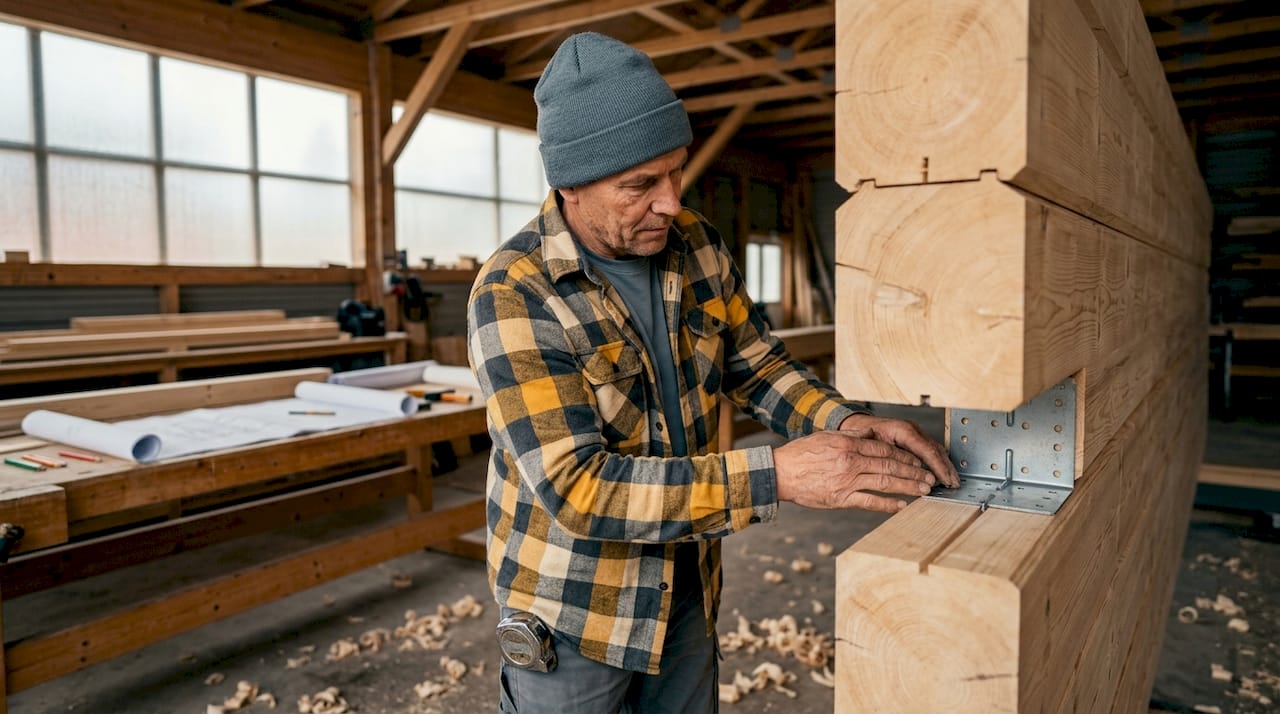
Pro Tip: If your project runs through autumn or winter, specify a detailed wrapping and handling protocol for every module before it leaves the factory. Moisture that enters joints during transport or overnight storage can cause swelling, staining, and joint failure that only becomes visible months later.
Why Finnish climate demands more:
- Temperature swings between seasons are extreme, meaning timber movement is significant and joints must accommodate expansion and contraction.
- Snow loads in northern Finland can reach 3.0 kN/m² or more on roofs, requiring structural connections designed for these regional values.
- Remote site access often means modules cannot be repositioned easily if a fit-up problem arises, so tolerances must be tighter and checked before departure from the factory.
- Short summer build windows in northern regions mean every day of site assembly counts. Delays from poor connections or moisture damage are expensive.
Finnish craftsmanship traditions have always prioritized durability over speed, and that philosophy carries directly into how good modular timber projects are planned here. It is not enough to build fast. You have to build in a way that survives a century of Finnish weather.
Module connections: the key to performance
Here is where many modular timber projects either succeed or struggle. The quality of connections between modules, not the quality of the timber inside each module, is often what separates a building that performs well from one that develops problems over time.
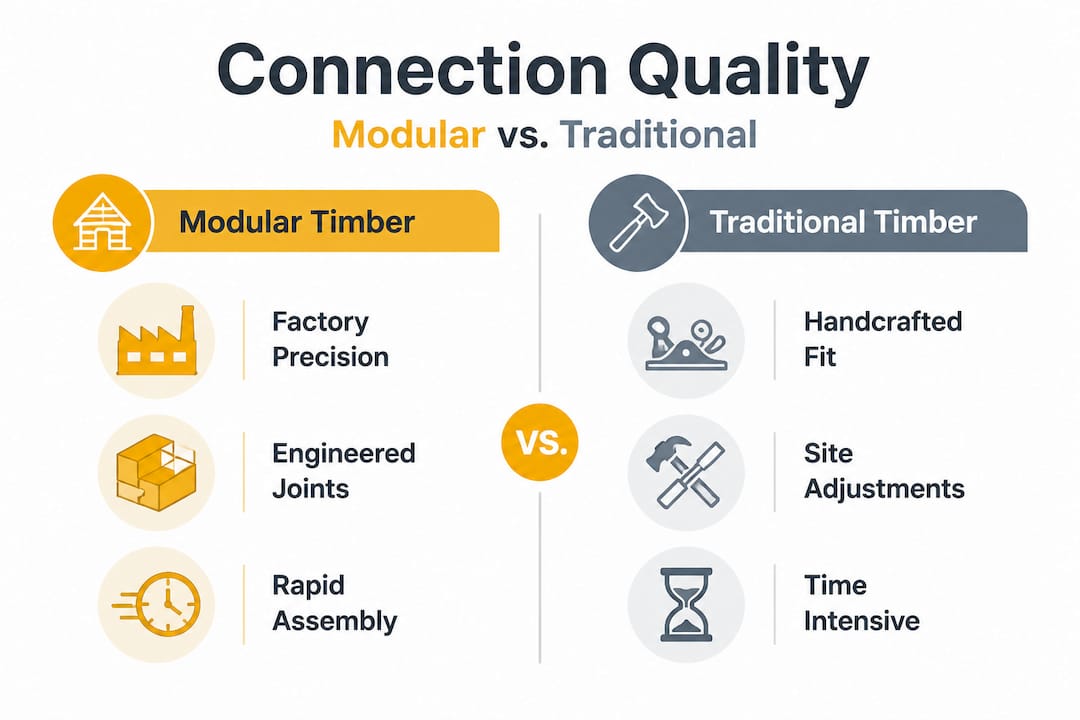
A key mechanics nuance in multi-module timber buildings is that inter-modular connections can govern lateral (racking) behavior through slip and shear deformation, not just the in-module shear walls. In plain language: when wind pushes sideways against your building, it is the joint between two modules, not the walls inside each module, that may be the weakest link.
This matters enormously for Finnish projects because:
- Wind loads in coastal and open areas are significant.
- Multi-story cottages or villas stack modules vertically, increasing the demand on horizontal connections.
- Timber creeps and moves seasonally, so connections designed for a static load may loosen over time if not properly engineered.
What poor connections cause:
- Gaps that allow cold air and moisture to enter between modules (directly affecting heating costs and interior comfort in Finnish winters).
- Racking or twist in the structure that makes doors and windows difficult to operate.
- Noise transfer between modules, which matters especially in multi-unit or multi-room configurations.
- Long-term structural drift that is difficult and expensive to correct after finishing work is done.
| Connection factor | Good practice | Poor practice |
|---|---|---|
| Lateral load design | Engineered for site-specific wind and snow loads | Generic hardware, no site calculation |
| Sealing at joints | Pre-compressed tapes and flexible membranes | Silicone applied on-site only |
| Tolerance management | Modules checked against 3D model before delivery | Adjusted with shims at site |
| Fastener specification | Engineered connectors with load ratings | Standard timber screws |
| On-site inspection | Structural engineer checks connection completion | Builder self-certifies |
“The structural value of a modular timber building depends more on how modules are connected than on how they are built individually. A well-made module joined poorly will underperform a simpler module joined correctly.”
Pro Tip: Ask your timber manufacturer for engineered connection details, not just a materials list. The detail drawing showing how two modules meet, seal, and transfer load is more important than the specification of the timber inside each module. If they cannot produce it, that is a red flag worth taking seriously.
Log home construction has taught Finnish builders for centuries that where two elements meet is always where failure begins if the detail is not right. Modular timber is no different. It just moves that critical meeting point from the forest to the factory.
Digital modeling and Finnish standards
Modern modular timber projects rely heavily on digital tools to coordinate complex systems and prevent errors before a single piece of timber is cut. This is not just a trend borrowed from commercial construction. It is a practical necessity for projects where factory tolerance and site tolerance must match precisely.
Here is how digital modeling fits into a well-run modular timber workflow:
- Architectural design is converted to a 3D building information model (BIM). Every wall, floor, roof, and opening is modeled with exact dimensions and material specifications.
- Structural engineers add connection details and load calculations to the model. This is where inter-module connections are designed, not left as site decisions.
- The factory uses the model to program cutting and assembly. Errors in the drawing are caught in software before they become errors in timber.
- Clash detection identifies conflicts between structural elements, insulation layers, and services (pipes, cables) before manufacturing begins.
- Installation sequences are checked in the model. Teams can see which module is placed first, which cranes are needed, and how services connect between modules.
- The completed model is handed over for permits. Finnish building permit authorities increasingly accept BIM-based documentation.
TIM 2025 provides Finnish guidance for modeling industrial timber element construction, including IFC information content and a focus on connections and fasteners, which is directly relevant for modular timber coordination workflows. This means Finnish builders now have a national standard that tells designers exactly what to model and how to document it for permits and site teams.
The practical payoff is significant. Projects using coordinated BIM workflows before manufacturing see far fewer site surprises during assembly. When a module arrives at a remote Finnish site and the crane is booked for a single day, discovering that a connection detail was not modeled correctly is an expensive problem. Good digital coordination for timber builds eliminates most of those surprises before the truck leaves the factory gate.
What TIM 2025 covers that matters most to your project:
- IFC data requirements so that the digital model contains enough information to coordinate fabrication and assembly.
- Connection and fastener modeling so that every joint is documented, not assumed.
- Element identification so that every module or panel is traceable from factory to site.
- Coordination between disciplines so that architects, structural engineers, and MEP (mechanical, electrical, plumbing) designers all work from a single source of truth.
This kind of coordination was once reserved for large commercial projects. For Finnish cottages, saunas, and custom homes, it is now accessible and increasingly expected by experienced builders.
Perspective: what most Finnish builders miss about modular timber
Here is an opinion based on watching many modular timber projects succeed and struggle: the biggest mistake is treating modular as a “plug and play” system. People assume that because the hard work happens in the factory, the site work is easy. It is not. The site work is different, and in some ways more demanding, because the decisions that matter most were made weeks earlier.
Modular timber is not automatically simpler. The structural and buildability value depends entirely on connection strategy, especially inter-module connections for lateral loads. A beautifully crafted module joined to its neighbor with inadequate hardware and no sealing detail is a more expensive version of a traditional problem.
The Finnish builders who get this right do two things consistently. First, they treat the connection details as the most important design decision in the project, not an afterthought for site teams to solve. Second, they insist on a single team responsible for both factory tolerance and site tolerance, so that the gap between “how it was made” and “how it was installed” is owned by one group of people.
The biggest design trap we see is homeowners spending months selecting timber species, interior finishes, and sauna sizes, while giving almost no attention to how modules meet at the roof, floor, and wall interfaces. Those interfaces are invisible in the finished building. They are not exciting to look at in drawings. But they are where the building’s long-term performance is decided. Invest your planning energy there, and the rest of the project tends to take care of itself.
Lasting Finnish craftsmanship was never about the visible finish alone. It was always about what holds the structure together through decades of use and weather. Modular timber, done correctly, carries that tradition forward with modern precision.
Connect with Finnish timber building experts
Understanding modular timber theory is one thing. Applying it to your specific site, budget, and design is where the real work begins. Whether you are planning a lakeside sauna, a countryside cottage, or a full custom home, getting the connection details and factory-to-site coordination right from day one saves time, money, and frustration.
At Huvila Seppälä, we have spent over 65 years manufacturing custom timber structures from Finnish wood, and we know that every project starts with a conversation about what you actually need. You can explore options for custom wooden villas or learn more about the specific properties that make Finnish wood the right material for buildings that need to last. If you want a clear, step-by-step picture of what your own project involves, our timber building guide walks you through each stage. We provide transparent quotes with no hidden costs, based on your own drawings, and we can start that process whenever you are ready.
Frequently asked questions
Are modular timber buildings suitable for winter construction in Finland?
Yes, factory-made modular systems can shorten winter build times significantly, but they require strict moisture and tolerance control to protect timber joints and finishes during transport and on-site assembly.
What makes modular timber assembly different from traditional timber building?
Modular timber uses factory-made volumetric modules transported for rapid on-site assembly, while traditional methods build the structure piece by piece directly at the building location.
What is the biggest risk when using modular timber for remote cottages?
The main risk is moisture entering connection joints during transport or stacking. Moisture at connection joints can impact structural performance and durability in ways that only become visible months or years after completion.
How does digital modeling with TIM 2025 help my modular timber project?
TIM 2025 offers Finnish standards and detailed guidance to ensure timber modules are designed, modeled, and coordinated with accurate connections and fasteners, reducing errors before manufacturing begins.
Recommended
- Finnish timber construction checklist: homeowner’s guide – Hirsitalot, pihasaunat ja piharakennukset kotimaisesta hirrestä
- Building regulations in Finland 2026: timber guide – Hirsitalot, pihasaunat ja piharakennukset kotimaisesta hirrestä
- Building Permits for Timber Homes in Finland: A Clear Guide – Hirsitalot, pihasaunat ja piharakennukset kotimaisesta hirrestä
- Why Build With Timber: Eco-Friendly Homes Explained – Hirsitalot, pihasaunat ja piharakennukset kotimaisesta hirrestä