Master the timber sauna assembly process: safe, lasting results
TL;DR:
- Proper site preparation and permits are essential to avoid structural issues and legal problems.
- Choosing the right timber species and ensuring low moisture content improves sauna durability and performance.
- Following a detailed assembly process with proper ventilation and thorough verification ensures long-lasting, safe sauna construction.
Building a custom timber sauna feels exciting until you realize you need permits, site surveys, structural plans, and the right wood species before you can even swing a hammer. Many Finnish homeowners and cottage developers stall at this exact point, unsure whether to hire a contractor or tackle it themselves. This guide walks you through every critical phase of timber sauna assembly, from early paperwork to final inspection, so you can move forward with confidence. Whether you are building on a lakeside lot or a rocky hillside property, the steps here reflect real Finnish construction practice and over 65 years of hands-on experience.
Table of Contents
- Planning and site preparation essentials
- Choosing the right timber and materials
- Step-by-step structural assembly process
- Interior finish, ventilation, and stove installation
- Verification, common pitfalls, and final approval
- Expert perspective: What most guides miss about timber sauna assembly
- Take your timber sauna project further with expert resources
- Frequently asked questions
Key Takeaways
| Point | Details |
|---|---|
| Plan and permit first | Secure all site plans and permits before starting your sauna build to avoid costly setbacks. |
| Pick quality timber | Choose moisture-resistant, local woods with verified moisture content for lasting structure and comfort. |
| Follow assembly steps | Proper sequencing and careful insulation, vapor barrier, and ventilation are key to sauna safety and efficiency. |
| Verify for safety | Check moisture, structure, and all joints before final approval to prevent mold and ensure compliance. |
Planning and site preparation essentials
Begin by laying the groundwork, literally and administratively, to ensure your sauna build starts strong. Most first-timers underestimate how much preparation happens before a single log is placed.
The timber sauna assembly process for custom builds in Finland typically begins with site preparation and securing local building permits, as municipalities have specific zoning and documentation requirements including site surveys and structural plans. Skipping this step is not just risky, it can result in a demolition order after the build is complete.
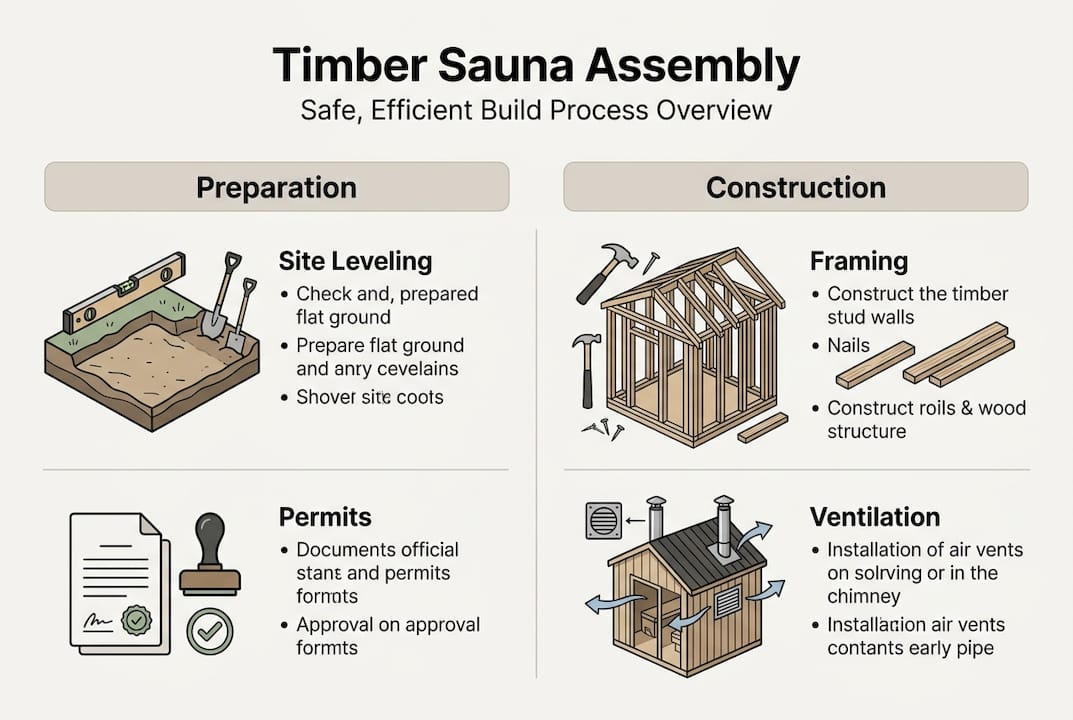
Before you submit anything, review the Finland sauna requirements for your municipality, since setback distances and allowable footprints vary by region. The permit process guide and sauna prerequisites pages can help you gather the right documents from the start.
Here is what your site checklist should cover before breaking ground:
- Access route wide enough for material delivery vehicles
- Drainage sloping away from the foundation to prevent water pooling
- Setback distances from property lines, water bodies, and neighboring structures
- Electrical planning including cable routing and load capacity for the stove
- Ground survey confirming soil stability and any rock formations
Pro Tip: Contact your local municipality before hiring any contractors. A 30-minute conversation with a building inspector can save you weeks of back-and-forth on permit revisions.
Safety warning: Never skip a proper site survey. Building on unmapped rock formations or poor drainage zones creates structural risks and can trigger mandatory demolition orders years after completion.
For timeline planning, professional teams typically complete a timber sauna in 4 to 12 weeks. DIY builders should realistically expect two to three times that, especially when managing permits, deliveries, and unfamiliar techniques simultaneously.
Choosing the right timber and materials
Once your site is ready and paperwork in order, the next critical choice is your building material. Timber selection shapes the sauna’s heat performance, longevity, and feel for decades.
Nordic wood species like spruce, pine, and cedar are prioritized for their thermal efficiency, moisture resistance, and durability. Spruce is cost-effective and widely available, while cedar is aromatic and exceptionally long-lasting in humid conditions.
| Timber | Cost | Thermal performance | Moisture resistance | Best use |
|---|---|---|---|---|
| Spruce | Low | Good | Moderate | Structural framing |
| Pine | Low to medium | Good | Good | Framing and cladding |
| Cedar | High | Excellent | Excellent | Exterior and cladding |
| Aspen | Medium | Moderate | Good | Interior benches and walls |
| Birch | Medium | Moderate | Good | Interior finishing |
Moisture content is one of the most overlooked specs. Timber used in sauna construction should have a moisture content below 20%. Wood above this threshold shrinks unevenly as it dries inside the heated structure, causing gaps, warping, and vapor barrier failures.
Softwoods like spruce and pine are hygroscopic, meaning they absorb and release moisture naturally. This property actually helps regulate humidity inside the sauna, but only when the wood is properly dried before installation.
Beyond the structural timber, you will also need these secondary materials:
- Corrosion-resistant fasteners (stainless steel or galvanized)
- Mineral wool or fiberglass insulation rated for high-humidity environments
- Type C foil vapor barrier to block moisture migration into wall cavities
- Battening strips to create ventilation gaps behind interior cladding
Pro Tip: Use high-grade aspen or birch for interior surfaces. Both species stay cool to the touch even at high temperatures, which matters when your skin is in direct contact with benches and walls.
Step-by-step structural assembly process
With your wood and fasteners ready, follow these assembly steps to ensure safety and energy performance throughout the build.
Structural framing uses treated 2×4 lumber with 16-inch stud spacing, ceiling height kept under 7 feet, insulation with R-11 to R-13 fiberglass batts for walls (higher values for ceilings), followed by a Type C foil vapor barrier and battening for ventilation gaps. For log construction, logs are horizontally interlocked with notches, emphasizing precision in milling or handcrafting, pre-treated for moisture, and assembled on-site or as prefab units.
| Component | Material | Insulation value | Typical labor hours |
|---|---|---|---|
| Wall framing | 2×4 lumber | R-11 to R-13 | 8 to 12 hours |
| Ceiling | 2×6 lumber | R-19 to R-30 | 4 to 6 hours |
| Vapor barrier | Type C foil | N/A | 2 to 4 hours |
| Log walls (hirsitalo) | Interlocked logs | High mass | 16 to 30 hours |
Follow this numbered sequence for classic frame construction:
- Set and level the foundation slab or piers
- Frame the floor platform with pressure-treated sill plates
- Erect wall studs at 16-inch spacing and secure the top plate
- Install ceiling joists sloping higher over the bench area than over the stones
- Add insulation batts between studs and ceiling joists
- Install the Type C foil vapor barrier on the warm side of insulation
- Batten out the interior walls to create a ventilation gap
- Proceed to interior cladding and bench framing
For log sauna assembly, the sequence shifts to stacking and notching logs, checking for plumb and level at every course, and sealing log joints with natural fiber chinking. You can find more detail on custom timber assembly for both methods.
“The ceiling must slope higher over the benches than over the stones for even heat distribution throughout the sauna.”
Interior finish, ventilation, and stove installation
Once your main structure is standing, shift focus to interior work and the components critical for authentic sauna comfort.
Interior finishing involves tongue-and-groove paneling in species like aspen or birch, benches set between 18 and 40 inches in height, stove installation (electric or wood-burning with dedicated circuits), and ventilation with the inlet positioned low and the outlet positioned high for proper air circulation.
Follow this sequence for interior work:
- Install tongue-and-groove wall cladding over battens, leaving a gap at the floor for air intake
- Fit the ceiling cladding, ensuring the vapor barrier lap joints are sealed
- Build lower and upper bench frames using aspen or birch, checking for level
- Set upper bench height at 36 to 40 inches for the hottest zone
- Install the stove on a non-combustible hearth pad, following manufacturer clearances
- Connect electrical circuits with a dedicated breaker for electric stoves
- Cut and seal the ventilation inlet near the floor and the outlet near the ceiling on the opposite wall
For a complete Finnish-style interior, use the log sauna checklist to confirm every element before closing up walls.
Safety checklist before first use:
- Electrical wiring inspected by a licensed electrician
- Stove clearances verified against manufacturer specs
- Bench edges sanded smooth with no protruding fasteners
- Ventilation flow tested by holding a tissue near the inlet and outlet
Pro Tip: Position the ventilation outlet higher than the inlet on the opposite wall. This creates the natural convection loop that Finnish builders call löyly circulation, giving you even, comfortable steam distribution rather than hot spots.
Verification, common pitfalls, and final approval
Before you light your first stove, a thorough review and correction of any build errors ensures lasting health and compliance.
Final verification includes structural checks, moisture metering, professional inspection, and addressing common pitfalls like poor vapor barrier installation leading to mold and inadequate ventilation. Use the timber sauna checklist to work through each item systematically.
Work through these verification steps before calling for inspection:
- Structural integrity: check all framing connections, log notches, and anchor bolts
- Moisture content: meter the installed timber and confirm it reads below 20%
- Vapor barrier continuity: inspect every seam, penetration, and corner for gaps or tears
- Electrical safety: confirm all wiring is rated for sauna temperatures and properly grounded
- Ventilation test: run the stove and verify airflow at both inlet and outlet
“A failing vapor barrier is the number one reason for mold in new saunas, and it is almost always invisible until the damage is already done.”
The three most frequent mistakes builders make are: installing the vapor barrier with unsealed laps, accidentally blocking ventilation paths with insulation, and skipping the final moisture meter check on delivered timber. Each one is easy to fix before closing up walls but expensive to repair afterward.
For professional inspection, your municipality will typically review structural drawings, electrical sign-off, and a completed building notice. Having all documents organized in advance speeds the process considerably.
Expert perspective: What most guides miss about timber sauna assembly
Most online guides treat sauna assembly as a purely mechanical process. Measure, cut, fasten, repeat. But after working with Finnish builders for over 65 years, we have noticed that the projects with the best long-term outcomes share a few habits that rarely appear in instruction manuals.
First, moisture metering is treated as optional by many international DIYers. It is not. Logs that arrive at 25% moisture content and get sealed behind cladding will cause vapor barrier failures within two heating seasons.
Second, the traditional Finnish approach to heat ratios and bench layout is not just cultural preference. It is physics. The proportions used in classic Finnish saunas create convection patterns that modern open-plan designs often disrupt. Real-world build timelines consistently show that builders who follow traditional layouts report fewer heat complaints.
Third, do not underestimate the value of involving family or neighbors in the heavy lift and fitout phases. Beyond safety, it creates shared ownership of the space, which is very much part of the Finnish sauna tradition.
Take your timber sauna project further with expert resources
You now have a solid framework for planning, building, and verifying your custom timber sauna. The next step is going deeper on the details that match your specific site and design goals.
At Huvila Seppälä, we have spent over 65 years helping Finnish homeowners and cottage developers turn personal drawings into finished timber structures. Whether you are still deciding on materials or ready to request a quote, our guides on why build with timber and Finnish wood benefits give you the technical grounding to make confident choices. For a full project walkthrough, the custom timber cottage guide covers everything from foundation to final finish. Reach out for a transparent, no-hidden-cost quote tailored to your plans.
Frequently asked questions
How long does it take to assemble a timber sauna?
Professional timber sauna assembly in Finland usually takes 4 to 12 weeks, while DIY projects can run two to three times longer, especially with custom designs and challenging sites like rocky terrain.
Which timber is best for sauna construction?
Spruce, pine, and cedar are top choices due to thermal efficiency and moisture resistance, with aspen and birch widely preferred for interior finishes because they stay cool against the skin.
What are the most common mistakes when building a timber sauna?
The most frequent mistakes are poor vapor barrier installation, skipping moisture checks on delivered timber, and inadequate ventilation setup, all of which can cause mold growth or uneven heat distribution.
Do you need a building permit for a timber sauna in Finland?
Yes, permits are typically required and must be secured before construction begins because municipalities require site surveys and structural plans as part of strict zoning documentation rules.
Recommended
- Setting Up Finnish Sauna: Complete Step-by-Step Guide – Hirsitalot, pihasaunat ja piharakennukset kotimaisesta hirrestä
- Role of Wood in Sauna Building: Comfort, Safety, and Longevity – Hirsitalot, pihasaunat ja piharakennukset kotimaisesta hirrestä
- Role of craftsmanship in saunas: Finnish timber guide – Hirsitalot, pihasaunat ja piharakennukset kotimaisesta hirrestä
- How to Build Outdoor Sauna for Custom Finnish Style – Hirsitalot, pihasaunat ja piharakennukset kotimaisesta hirrestä