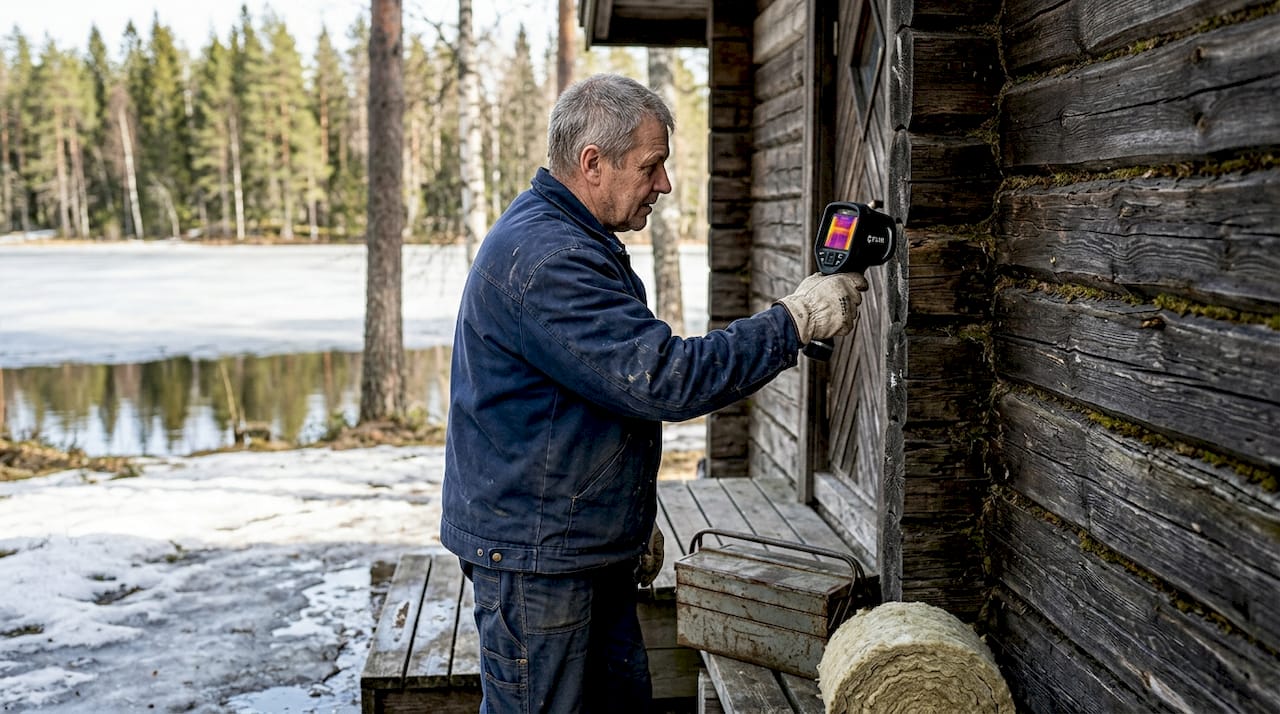
Log sauna insulation explained: essential guide for Finnish builds
TL;DR:
- Effective insulation and vapor barriers are crucial for sauna durability and energy efficiency in Finnish winters.
- Mineral wool combined with sealed foil vapor barriers and ventilation gaps offers optimal moisture and thermal management.
- Incorporating flexible materials and proper installation details prevents issues caused by log settling and moisture buildup.
Many homeowners planning a log sauna in Finland assume that thick timber walls handle everything. They picture dense, heavy logs and think the insulation question is already answered. It isn’t. Log walls breathe, shift, and lose heat in ways that catch first-time builders off guard, especially during Finnish winters where outdoor temperatures regularly drop below -20°C. Getting insulation right is what separates a sauna that heats up in 30 minutes and stays dry for decades from one that struggles, sweats, and rots from the inside. This guide covers every layer of the system: materials, vapor barriers, ventilation, and the efficiency details that most guides skip entirely.
Table of Contents
- Why log saunas need insulation: Myths and realities
- Choosing the right insulation materials for log saunas
- Moisture and vapor control: How to avoid sauna disasters
- Optimizing insulation for energy efficiency and comfort
- Expert perspective: What most guides miss about log sauna insulation
- Next steps: Build your perfect sauna with expert support
- Frequently asked questions
Key Takeaways
| Point | Details |
|---|---|
| Insulation is essential | Proper insulation delivers superior energy savings and comfort, even with thick log walls. |
| Vapor barrier placement | Always install and seal vapor barriers on the warm interior side to prevent costly damage. |
| Ceiling needs most insulation | Use at least R-25 insulation in the ceiling to dramatically cut heat loss. |
| Ventilation prevents moisture issues | Never skip ventilation gaps or battens behind wall cladding to keep your sauna healthy. |
| Select materials carefully | Choose insulation materials to balance heat retention, moisture management, and sustainability. |
Why log saunas need insulation: Myths and realities
The most persistent myth in log sauna construction is simple: thick logs equal enough insulation. It feels logical. Wood is a natural insulator, and a 200 mm log wall does have genuine thermal mass. But thermal mass and thermal resistance are two different things. Thermal mass stores heat; thermal resistance slows its movement. In a Finnish winter, you need both, and logs alone don’t deliver enough resistance to keep heating costs reasonable or prevent moisture from causing serious damage.
Heat loss in a log sauna happens through every surface, not just the walls. The ceiling, floor, door frame, and any gaps around penetrations all bleed warmth. Without targeted insulation at these weak points, your heater works overtime and your energy bills climb. Log sauna energy savings depend heavily on how well the building envelope is sealed and insulated as a complete system.
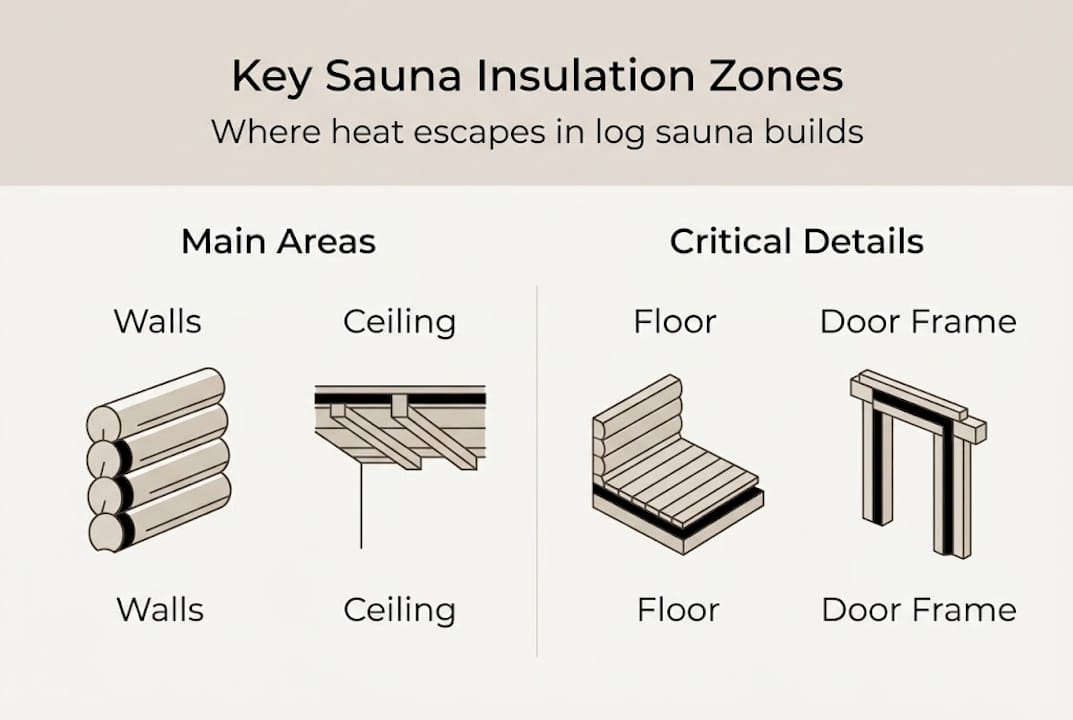
Moisture is the bigger threat that most people underestimate. A sauna generates enormous amounts of steam. That steam wants to migrate outward through the walls, and if it hits a cold surface before it exits, it condenses. Repeated condensation inside a wall cavity causes mold, rot, and structural damage that can compromise a sauna within a decade. The role of insulation in saunas goes far beyond temperature. It’s a moisture management system as much as a thermal one.
Here’s a quick breakdown of what logs do versus what insulation achieves:
- Logs provide: Structural strength, thermal mass, natural breathability, and aesthetic character
- Insulation provides: Thermal resistance (R-value), moisture redirection, condensation prevention, and energy efficiency
- Together they provide: A durable, comfortable, and cost-effective sauna that performs in Finnish conditions
“Vapor barrier must be on the warm interior side, fully sealed to prevent condensation damage.” Sauna Insulation Guide
This single rule, when ignored, is responsible for the majority of log sauna failures seen in Finnish builds. The vapor barrier isn’t optional or secondary. It’s the line between a sauna that lasts 50 years and one that needs major repairs in 10.
Choosing the right insulation materials for log saunas
Now that you know insulation is vital, let’s look at your options. Not all insulation materials behave the same way in a high-humidity, high-temperature environment like a sauna. The wrong choice can trap moisture, off-gas chemicals, or simply underperform when the heat is on.
Mineral wool is the most widely used option in Finnish sauna construction. It handles heat well, doesn’t burn, and allows some moisture vapor to pass through rather than trapping it. It’s also relatively affordable and easy to cut and fit around log profiles. The main drawback is that it must be paired with a properly installed vapor barrier, because mineral wool itself doesn’t stop moisture migration.
Wood fiber insulation is a more ecological choice that aligns well with the natural character of a log sauna. It has good thermal performance and handles moisture buffering better than mineral wool. It costs more, but for builders who want an all-natural material stack, it’s an excellent fit.
Polystyrene (rigid foam boards) offers high R-value per centimeter, which makes it useful in tight spaces. However, it doesn’t breathe at all, it’s petroleum-based, and it requires careful fire protection in sauna applications. Most Finnish builders avoid it for the main wall assembly and reserve it for specific areas like under-floor insulation.
Hemp insulation is gaining interest as a sustainable option. It handles moisture well and is naturally resistant to mold. Availability in Finland is improving, but it remains a specialty product with higher costs.
| Material | Thermal performance | Moisture handling | Eco-friendly | Install ease |
|---|---|---|---|---|
| Mineral wool | High | Moderate | Moderate | Easy |
| Wood fiber | High | Good | High | Moderate |
| Polystyrene | Very high | Poor | Low | Easy |
| Hemp | Moderate | Very good | Very high | Moderate |
For most Finnish log sauna builds, mineral wool combined with a foil vapor barrier is the proven workhorse combination. For hybrid framed-log designs, combining log exterior with mineral wool insulation and a foil vapor barrier delivers 30 to 40% energy savings compared to uninsulated or under-insulated builds. The thermal insulation in log houses follows similar principles, and lessons from log house construction translate directly to sauna projects.
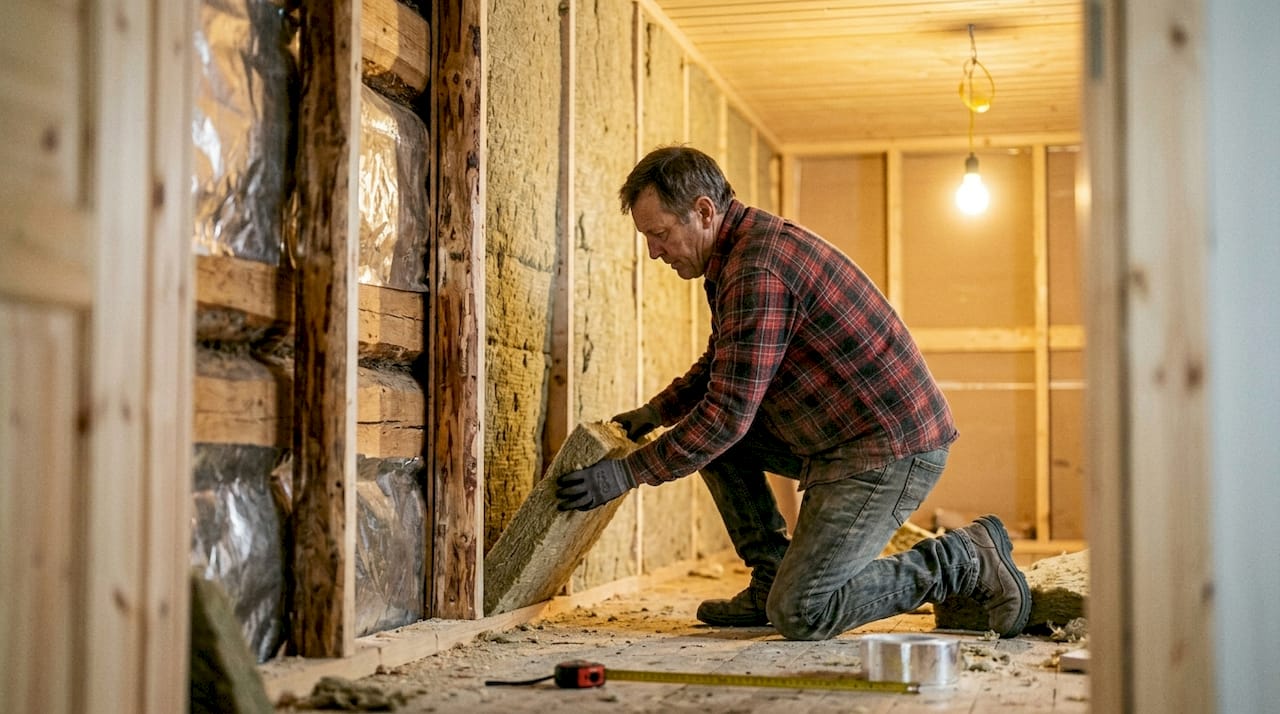
Pro Tip: Always seal every seam of your foil vapor barrier with proper foil tape, not standard duct tape. Foil tape maintains its bond in high-humidity, high-temperature conditions. Standard tape fails within a few sauna seasons, leaving gaps that allow moisture to penetrate the wall assembly and cause the exact damage you’re trying to prevent. This small detail has a massive impact on long-term energy efficiency in saunas.
Moisture and vapor control: How to avoid sauna disasters
Material choice is set. The next critical factor is moisture management. This is where many otherwise well-built saunas go wrong, not because the builder used bad materials, but because the installation sequence or vapor barrier placement was off by just enough to cause problems years later.
Here’s the correct sequence for vapor barrier installation:
- Install insulation between studs or behind log cladding, ensuring full coverage with no gaps or compressed areas
- Apply the vapor barrier directly on the warm interior side of the insulation, running it continuously from floor to ceiling with generous overlaps at seams
- Seal every seam and penetration with foil tape, including around electrical boxes, pipe penetrations, and corners
- Install battens over the vapor barrier to create a ventilation gap before attaching interior cladding
- Attach interior cladding to the battens, leaving the air gap intact behind it
That ventilation gap in step four is critical and often skipped. Over-insulation traps moisture; always include ventilation gaps and battens behind cladding to allow any moisture that does penetrate to escape rather than accumulate. Without this gap, even a perfectly installed vapor barrier can be undermined by moisture that finds its way in through minor imperfections.
Pro Tip: Pay extra attention to the ceiling vapor barrier. Hot air and steam rise, so the ceiling takes the heaviest moisture load of any surface in the sauna. Any gap or unsealed seam in the ceiling barrier is a direct path for steam to reach the cold roof structure above, where it will condense and cause rot.
The must-have moisture control features for any Finnish log sauna are:
- Continuous foil vapor barrier on the warm interior side
- All seams sealed with foil tape
- Ventilation gaps behind interior cladding
- Ceiling insulation at the highest R-value in the building
- Adequate fresh air ventilation to prevent pressure buildup
Skipping any of these steps doesn’t just risk mold. It risks structural damage to the log frame itself. Good log sauna maintenance starts with getting the construction details right the first time.
Optimizing insulation for energy efficiency and comfort
Once moisture risks are controlled, proper insulation unlocks real efficiency gains. The most important and most overlooked detail is this: the ceiling is where you lose the most heat. Hot air rises, and in a sauna, the temperature differential between the ceiling and the floor can be 30°C or more. That heat wants to escape upward, and thin ceiling insulation lets it.
The ceiling needs the highest R-value in the building, targeting R-25 as a minimum. This typically means at least 200 mm of mineral wool in the ceiling assembly. Walls can get away with less, but skimping on the ceiling is the single fastest way to increase your heating time and energy costs.
| Location | Recommended R-value | Typical thickness (mineral wool) |
|---|---|---|
| Ceiling | R-25 minimum | 200 mm or more |
| Walls | R-15 to R-20 | 100 to 150 mm |
| Floor (if insulated) | R-10 to R-15 | 75 to 100 mm |
Proper insulation at these levels cuts heating time noticeably. A well-insulated sauna reaches temperature faster because less heat is escaping while the heater works. It also holds temperature more evenly, which is what creates the genuine Finnish sauna experience: consistent, enveloping heat rather than a hot spot near the heater and cold drafts near the door.
A checklist of features that maximize efficiency:
- Ceiling insulation at R-25 or above
- Airtight door with proper seals to prevent cold air infiltration
- Correctly sized heater matched to the insulated volume, not the raw room size
- Window placement on non-prevailing-wind walls to reduce heat loss
- Insulated floor especially for saunas on a slab or over a crawl space
For deeper guidance on the full planning process, the energy efficiency strategies for log saunas and the log sauna building checklist are worth reviewing before you finalize your design.
Expert perspective: What most guides miss about log sauna insulation
Most insulation guides treat the topic as a simple math problem: more insulation equals better performance. In our experience building log saunas in Finland for over 65 years, that’s only half true. There’s a point where adding more insulation to the walls starts working against you by reducing the log’s natural breathability and creating a sealed box that demands perfect vapor control at every single point. One small gap in an over-sealed wall becomes a bigger problem than it would be in a more balanced assembly.
Log settling is another detail almost nobody talks about. Logs move. They shrink and expand seasonally, and over the first few years of a new build, settling can be significant. Insulation systems that don’t account for this movement develop gaps and compressions that undermine both thermal and moisture performance. A rigid, over-engineered insulation stack can crack or shift as the logs settle beneath it.
The lesson from real Finnish builds is to treat insulation as a system with intentional flexibility. Plan for movement. Use materials that can accommodate minor shifts. And always prioritize the vapor barrier and ventilation details over chasing maximum R-values. For anyone in the custom log sauna planning phase, building this flexibility into the design from the start saves significant trouble later.
Next steps: Build your perfect sauna with expert support
Understanding insulation principles is the foundation, but translating that knowledge into a successful build takes careful planning and the right partners. At Huvila Seppälä, we’ve been manufacturing custom log structures from Finnish wood for over 65 years, and we know how much the details matter.
Whether you’re working through the log cabin building process for the first time or refining the details of a custom sauna project, our team can help you get the insulation strategy right from day one. Our step-by-step cottage building guide walks through every phase of a timber build, including the moisture and insulation decisions that determine long-term performance. Reach out for a personalized quote with no hidden costs, and let’s build something that lasts.
Frequently asked questions
What insulation should I use for a log sauna in Finland?
Mineral wool or wood fiber, combined with a properly sealed foil vapor barrier, are the preferred choices for Finnish log saunas. For hybrid framed-log designs, mineral wool with a foil vapor barrier delivers the best balance of performance and cost.
Where does the vapor barrier go in a sauna wall?
The vapor barrier must be installed on the warm interior side of the insulation and sealed completely with foil tape to block condensation from reaching the wall structure.
How thick should sauna ceiling insulation be?
Target at least R-25 in the ceiling, which typically requires 200 mm or more of mineral wool. The ceiling needs the highest R-value in the sauna because hot air and steam concentrate there.
What happens if saunas are over-insulated?
Over-insulation traps moisture inside the wall assembly, increasing the risk of mold and structural rot. Ventilation gaps behind interior cladding are essential to allow any accumulated moisture to escape.
Recommended
- Setting Up Finnish Sauna: Complete Step-by-Step Guide – Hirsitalot, pihasaunat ja piharakennukset kotimaisesta hirrestä
- Essential sauna prerequisites: build your outdoor retreat – Hirsitalot, pihasaunat ja piharakennukset kotimaisesta hirrestä
- Role of Insulation in Saunas – Energy and Comfort Impact – Hirsitalot, pihasaunat ja piharakennukset kotimaisesta hirrestä
- Build your Finnish outdoor sauna step by step in 2026 – Hirsitalot, pihasaunat ja piharakennukset kotimaisesta hirrestä