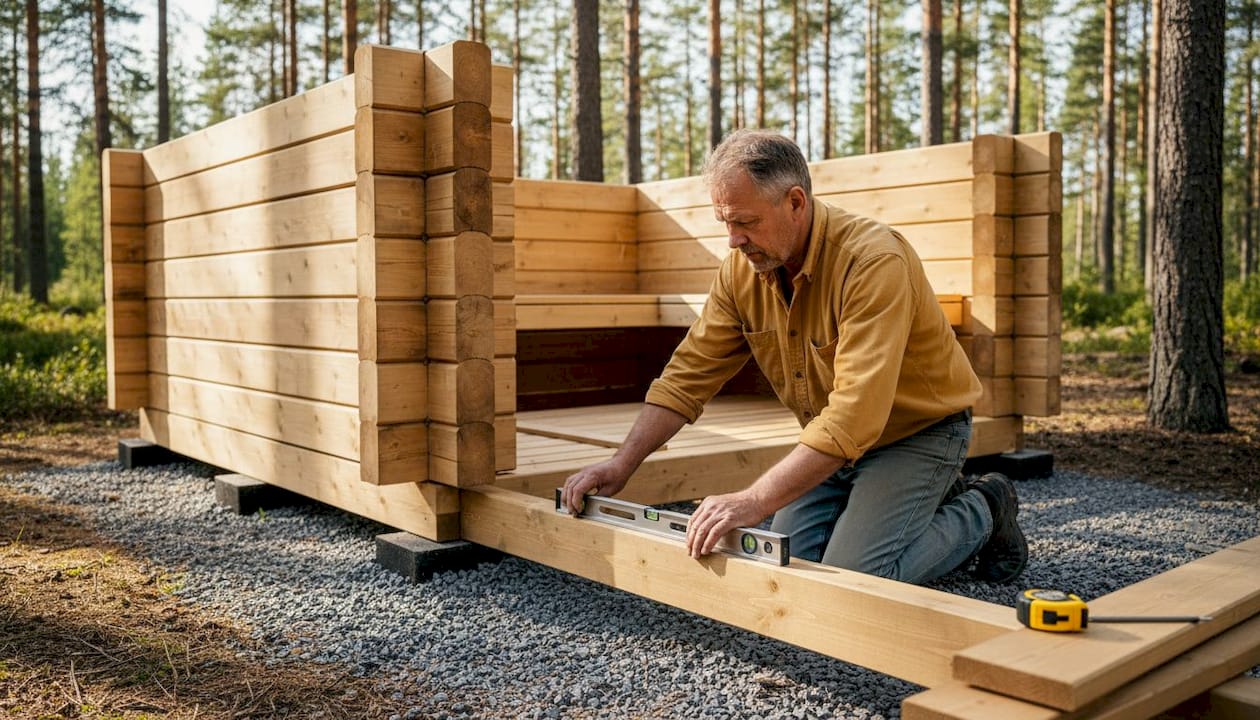
Sauna foundations explained: Build stable timber saunas
TL;DR:
- A sauna foundation is a vital load-bearing base that ensures stability, moisture protection, and longevity for the structure. Choosing the appropriate type depends on site conditions such as soil, drainage, slope, and climate, with options including gravel bases, concrete slabs, pavers, and deck systems. Proper installation and site assessment are crucial to prevent future settling, moisture issues, and structural failure, making site-specific planning indispensable.
Most people spend months agonizing over the wood species, stove type, and bench layout for their dream sauna. The foundation? An afterthought. That planning gap turns into a very expensive mistake. Foundation choice is often driven by site drainage and soil behavior, and getting it wrong leads to settling, moisture damage, and structural failure that no amount of beautiful Finnish timber can fix. This guide walks you through everything you need to know about sauna foundations: what they are, which type fits your site, how to install them correctly, and how to keep them performing for decades.
Table of Contents
- What is a sauna foundation and why is it essential?
- Types of sauna foundations: pros, cons, and key differences
- How to choose the right foundation for your site
- Installation tips: Ensuring stability and longevity
- Why the best sauna foundations are about more than materials
- Ready to build your perfect timber sauna? Explore next steps
- Frequently asked questions
Key Takeaways
| Point | Details |
|---|---|
| Foundation matters most | A stable, well-chosen foundation prevents settling, water damage, and costly repairs. |
| Match type to site | Choose your foundation based on local soil, drainage, and climate for best results. |
| Stepwise site prep is crucial | Carefully plan, level, and prepare the site before installation for maximum longevity. |
| Long-term savings | Investing in the right foundation saves time and money over the life of your sauna. |
| Expert help available | Specialist guides and resources can simplify building a lasting sauna foundation. |
What is a sauna foundation and why is it essential?
A sauna foundation is the load-bearing base layer that sits between your structure and the ground. It transfers the weight of your sauna evenly into the soil, keeps the floor level, and creates a barrier between your timber frame and the moisture, freeze-thaw movement, and biological activity happening underground.
For a timber sauna, the stakes are particularly high. Wood is vulnerable to prolonged moisture contact and movement. A foundation that shifts even a centimeter can pull apart log joints, warp door frames, and crack interior finishes. Once that process starts, it rarely stops on its own.
Here is what a well-designed sauna foundation actually does for you:
- Distributes the structural load evenly so no single point sinks faster than another
- Elevates the timber frame above grade to keep the sill logs dry
- Provides drainage pathways so rainwater and snowmelt move away from the structure
- Acts as a thermal buffer in freeze-thaw climates, reducing heave risk
- Creates a stable, level working surface for the full build
“Foundation choice is often driven by site drainage and soil behavior; recommendations repeatedly emphasize stable, well-drained, level support to prevent settling and moisture problems.”
Understanding these basics is the first step in any serious sauna construction basics research. The foundation does not generate heat, provide atmosphere, or show up in the design photos. But without it doing its job silently underground, nothing above it stays beautiful for long.
Common problems caused by a poor foundation include uneven floors that trap water, door frames that rack and stick, log walls that develop gaps as the structure shifts, and persistent dampness at floor level that accelerates wood rot. None of these are cheap to fix after the fact. Getting the foundation right during the build is always the better investment.
Types of sauna foundations: pros, cons, and key differences
Now that you understand what a foundation needs to accomplish, the logical next question is which type fits your project. There are four main categories used for outdoor saunas, and each has a genuine sweet spot.
Gravel base: A layer of compacted gravel, usually 4 to 6 inches deep, laid over a geotextile membrane. It drains well, requires no curing time, and costs less than any other option. Best suited for smaller backyard saunas on stable, relatively flat ground in mild climates.
Concrete slab: A poured or pre-cast concrete surface, typically 4 inches or more thick, often reinforced with rebar or wire mesh. It is rigid, permanent, and handles heavy timber frames without any flex. It costs more and requires more prep work, but it is the go-to solution in climates with significant frost depth.
Pavers or flagstone: Individual units set on a compacted gravel bed. Visually attractive, easy to adjust, and forgiving of minor ground movement. However, pavers can shift individually over time, creating unlevel surfaces if the base is not prepared carefully.
Deck or post system: Pressure-treated timber or concrete piers set below frost line, with a deck platform built on top. This lifts the sauna off the ground, improves underfloor airflow, and handles sloped or uneven terrain extremely well. It requires more carpentry skill but offers excellent long-term performance on challenging sites.
| Foundation type | Best for | Drainage | Install complexity | Relative cost | Freeze-thaw performance |
|---|---|---|---|---|---|
| Gravel base | Small saunas, mild climates | Excellent | Low | $ | Moderate |
| Concrete slab | Permanent builds, heavy frames | Good | High | $$$ | Excellent |
| Pavers | Aesthetic installs, mild to moderate | Good | Moderate | $$ | Moderate |
| Deck/post system | Sloped sites, cold climates | Excellent | High | $$$ | Excellent |
| Hybrid (gravel + slab) | Medium-weight builds, variable soil | Very good | Moderate | $$ | Good |
Gravel bases on geotextile are often recommended as a starting point, while concrete provides the permanence needed in harsh freeze-thaw climates. Choosing between them is not about which is technically superior. It is about which one suits your specific conditions.
Factors that push you toward one type or another include frost depth in your region, existing slope on the site, the total weight of your sauna structure, local building permit requirements, and your budget for both initial install and long-term maintenance. Reviewing your options for sauna foundation materials in detail before committing will save you from regret later.

Pro Tip: If your region experiences freeze-thaw cycles of any significance, design your foundation for those conditions rather than average weather. The worst-case frost event, not the average winter, determines whether your foundation holds.
For a detailed breakdown of the full sauna building steps, including how the foundation integrates with the rest of the structure, it helps to see the complete picture before breaking ground.
How to choose the right foundation for your site
Armed with the comparison above, you now need a clear method for picking the right option for your specific land and structure. Site evaluation is not glamorous work, but it is the most important 90 minutes you will spend on this project.
Follow this process before finalizing any foundation decision:
- Walk the site after heavy rain. Watch where water pools, where it drains naturally, and how long it takes to disappear. A site that stays wet for more than 24 hours needs active drainage improvement before any foundation goes in.
- Do a simple soil test. Dig down 12 inches and examine what you find. Sandy or gravelly soil drains well and compacts predictably. Clay-heavy soil holds water, expands when wet, and shrinks when dry. Clay soil demands either deep concrete work or a raised post system.
- Research local frost depth. Your local building department will have this data. If the frost line in your area is 24 inches or deeper, surface-level foundations like gravel or pavers alone may not be adequate for a permanent structure.
- Measure your slope. A slope greater than 6 inches across the footprint of your sauna will need to be either graded or addressed with a post and beam system. Trying to work around significant slope with a surface foundation creates long-term problems.
- Confirm sauna weight and footprint. A small 6×8-foot sauna weighs very differently from a 12×16-foot log sauna with a traditional Finnish log stove. Heavier structures need more load distribution and more rigid foundations.
| Site condition | Recommended foundation |
|---|---|
| Flat, well-drained sandy soil | Gravel base on geotextile |
| Flat, clay-heavy soil | Concrete slab with drainage layer |
| Mild slope, stable ground | Deck/post system or compacted gravel |
| Steep slope or irregular terrain | Post and pier system below frost line |
| Severe freeze-thaw climate | Concrete slab or deep pier system |
| Soft or organic soil | Deep piers or engineered solution |
Foundation choice is often driven by site drainage and soil behavior, which is exactly why no single foundation type wins every situation. The right answer for your neighbor’s sauna on sandy loam may be entirely wrong for your clay-heavy hillside lot.
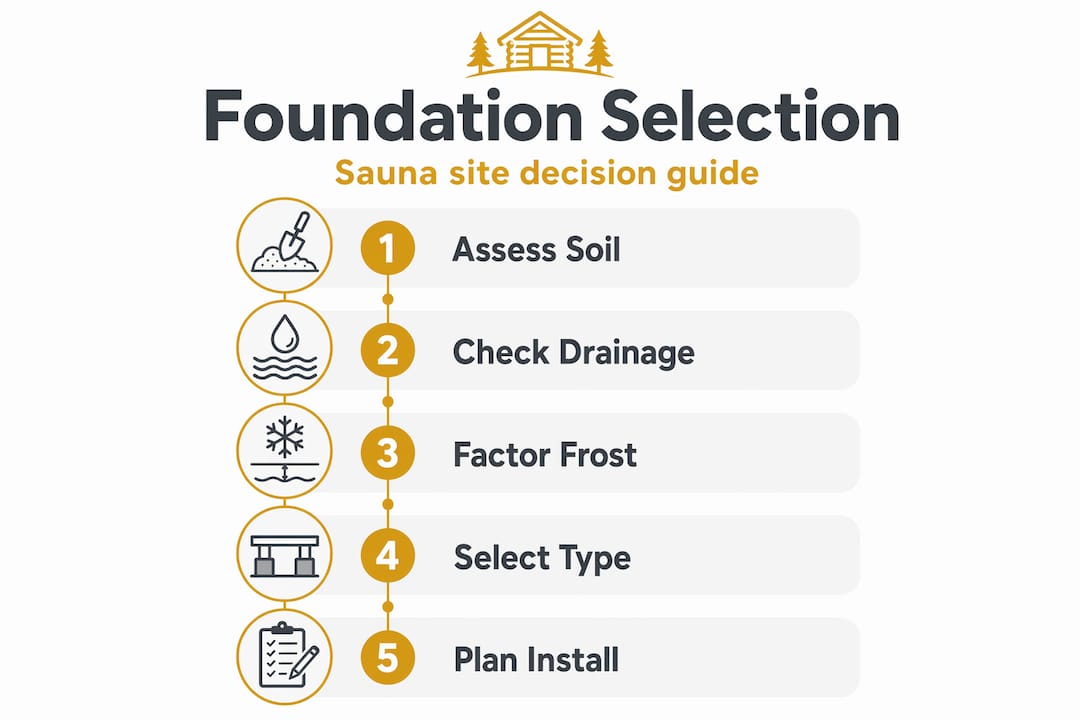
Thorough sauna site planning before you order materials or dig a single hole protects your investment from the start. Once you have matched your site to a foundation type, you can also confirm how your foundation plan interacts with local permit requirements by reviewing a sauna setup guide that covers the regulatory side of the build.
Balancing cost, ease, and durability means accepting that the cheapest option is not always the wisest one. A gravel base may cost half as much upfront, but if your soil is clay-heavy and your climate sees deep frost, you will be releveling your sauna every few years. That cost adds up faster than a well-designed concrete slab.
Installation tips: Ensuring stability and longevity
Choosing the right foundation type gets you 50 percent of the way there. Installing it correctly covers the other half. Shortcuts taken during installation show up as problems later, often after the first or second winter has done its work on the ground.
Here is a reliable installation sequence that applies to most sauna foundation types:
- Clear and strip the site. Remove all organic material, grass, roots, and topsoil from the full foundation footprint plus 12 inches beyond the edges. Organic material decomposes, creating voids that cause settling.
- Establish a level reference. Use stakes and a builder’s level to establish a consistent elevation across the entire area. Every subsequent step depends on this reference being accurate.
- Improve drainage if needed. If the site retains water, excavate a shallow drainage trench around the perimeter and fill with gravel. For clay sites, consider a French drain or deeper excavation before placing the foundation layer.
- Lay geotextile membrane. This landscape fabric prevents weeds from growing through your gravel base and stops fine soil particles from migrating up and contaminating your drainage layer over time.
- Place and compact your base material. For gravel bases, add material in 2-inch lifts and compact each layer before adding the next. For concrete, ensure the sub-base is firm and level before pouring. Never pour onto soft or wet soil.
- Install piers or slab according to plan. Follow your structural design for placement and depth. Concrete piers should reach below the local frost line without exception.
- Allow full cure time before building. Concrete needs a minimum of 7 days before loading, and 28 days to reach full design strength. Rushing this phase is one of the most common and damaging mistakes.
Recommendations repeatedly emphasize stable, well-drained, level support to prevent settling and moisture problems. Every shortcut in the list above compromises at least one of those three qualities.
Common mistakes to avoid during installation:
- Skipping compaction steps to save time
- Using topsoil or garden soil as fill material
- Underestimating frost depth and placing piers too shallow
- Ignoring surface drainage and hoping for the best
- Building directly on grade without any moisture barrier
For a complete picture of what site preparation looks like before any materials arrive, the sauna site preparation guide covers permits, drainage assessments, and utility checks in practical detail. You can also find specific techniques for different site types in the outdoor sauna building tips resource.
Pro Tip: In freeze-thaw climates, inspect your foundation each spring after the ground thaws. Look for any signs of heave, cracking, or movement. Catching a small shift early costs almost nothing to correct. Ignoring it until it becomes a structural problem costs significantly more.
Ongoing maintenance is simple but must not be skipped. Keep the area around the foundation clear of debris, ensure drainage channels stay open, and check timber sill plates annually for any signs of moisture penetration or early decay.
Why the best sauna foundations are about more than materials
After more than 65 years of working with timber structures, we have seen a consistent pattern. The projects that fail almost never fail because of the wrong wood species or the wrong stove. They fail because the foundation was designed for a different site than the one it was built on.
Homeowners often arrive at a project having researched the “best” foundation type online and committed to it before they have spent a single hour studying their actual ground conditions. They see concrete mentioned repeatedly and pour a slab on clay soil without drainage work. Or they read about gravel bases and use one in a region where frost depth reaches 36 inches. The material was not wrong in the abstract. It was wrong for that specific location.
The deeper lesson from the Finnish sauna workflow tradition is that the land always has the final say. Soil and water will work against even the most expensive materials if those materials are not matched to real site conditions. Finnish builders have understood this for generations. You design around the land, not despite it.
Spend more time studying your site than selecting your materials. A one-hour walk around your property after a rainstorm, combined with a basic soil evaluation and a frost-depth check, will tell you more than any product catalog. The right foundation for your sauna is the one that acknowledges what your ground actually does, not what you wish it would do.
Ready to build your perfect timber sauna? Explore next steps
Building a timber sauna that lasts for generations starts with getting the invisible parts right. The foundation work you do before a single log goes up determines how stable, dry, and structurally sound your sauna remains for the years ahead.
At Huvila Seppälä, we bring over 65 years of Finnish craftsmanship to every timber frame we manufacture, and we know that a great sauna starts long before the walls go up. Our detailed timber sauna building guide walks you through the full process from site prep to finishing. You can also explore the role of authentic Finnish woodworking for saunas and how traditional techniques translate into structures that perform in real northern climates. When you are ready to move from planning to building, we are here to help you do it right.
Frequently asked questions
Can I build a sauna foundation on uneven ground?
You should always level your site before building; uneven ground undermines stability and increases the risk of future settling or water problems. A post and pier system can accommodate slope without grading, but the structure itself must still be level.
How thick should a sauna slab foundation be?
Concrete slab foundations for saunas are typically at least 4 inches thick, but concrete provides permanence in harsh freeze-thaw climates and may need extra depth for heavy timber structures or cold regions. Always consult local building codes for minimum thickness requirements in your area.
What is the cheapest type of sauna foundation?
A gravel base is usually the lowest-cost foundation option, especially for small backyard saunas on stable ground. Gravel bases on geotextile are often recommended as an entry-level solution where soil and climate conditions allow it.
Should I use a vapor barrier under my sauna foundation?
Yes, a vapor barrier or geotextile membrane is strongly recommended to prevent moisture from migrating upward into your sauna from below. Gravel bases on geotextile are a standard approach precisely because this combination handles both drainage and vapor control effectively.
How can I protect my timber sauna from frost heave?
Use a foundation or pier system that extends below your local frost line, and ensure the surrounding grade slopes away from the structure to manage water. Concrete provides permanence in harsh freeze-thaw climates because deep poured foundations resist the upward movement that frost causes in shallow systems.
Recommended
- How to Build Outdoor Sauna for Custom Finnish Style – Hirsitalot, pihasaunat ja piharakennukset kotimaisesta hirrestä
- Sauna building workflow: plan and build Finnish sauna – Hirsitalot, pihasaunat ja piharakennukset kotimaisesta hirrestä
- Setting Up Finnish Sauna: Complete Step-by-Step Guide – Hirsitalot, pihasaunat ja piharakennukset kotimaisesta hirrestä
- Master the timber sauna assembly process: safe, lasting results – Hirsitalot, pihasaunat ja piharakennukset kotimaisesta hirrestä