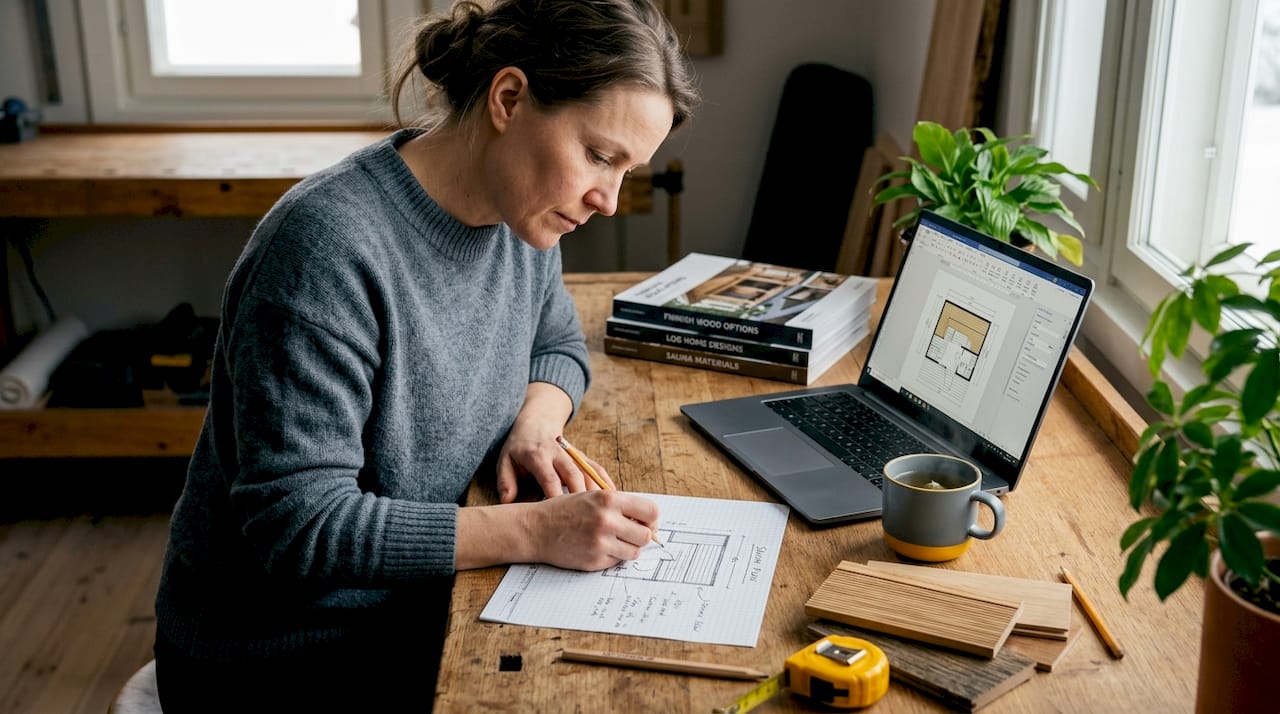
Design your custom sauna: step-by-step guide
TL;DR:
- Proper sauna planning, including site selection, materials, and ventilation, is essential to ensure durability, comfort, and efficiency. Correct sizing and ergonomic layout of benches, along with appropriate material choices, create a safe and relaxing environment that withstands Finnish climate conditions. Integrating thoughtful ventilation and heater placement based on precise calculations guarantees optimal air quality, moisture control, and overall sauna performance.
Many sauna enthusiasts spend months saving up for their dream outdoor sauna, then rush through the planning stage only to end up with a space that overheats in minutes, drains their wallet on electricity, or starts rotting within a few years. The truth is that poor planning—not poor materials or cheap heaters—causes most sauna failures. A well-thought-out design workflow protects your investment, maximizes comfort on cold Finnish nights, and makes the whole build process far smoother. This guide walks you through every essential step, from site selection to heater sizing, so you can create a custom sauna built to last.
Table of Contents
- Essential preparations: space, site, and requirements
- Choosing size and layout: maximize comfort and efficiency
- Material selection for durability and experience
- Ventilation strategy: air quality and moisture control
- Heater selection and integrating all elements
- A Finnish perspective: what most guides miss about truly great sauna design
- Bring your custom sauna vision to life with Finnish expertise
- Frequently asked questions
Key Takeaways
| Point | Details |
|---|---|
| Start with smart planning | Choosing the right site, layout, and workflow avoids most costly mistakes. |
| Ventilation is critical | Proper air intake and exhaust design ensure comfort and prolong sauna life. |
| Size heater to space | Calculate 1 kW per 1 m³ of sauna volume and adjust for special conditions. |
| Material choice matters | Durable, toxin-free materials improve safety, comfort, and moisture resistance. |
| Finish with integration | Double-check every system—layout, benches, ventilation, heater—works together before building. |
Essential preparations: space, site, and requirements
Now that you know why planning matters, let’s break down the very first decisions you’ll need to make on your sauna journey.
Before you sketch a single floor plan, you need to answer the big foundational questions: Where exactly will the sauna sit? What does Finnish regulation require? And in what order should you make these decisions? A practical sauna design workflow follows this sequence: start with (1) size and layout, then (2) materials, then (3) ventilation placement and duct sizing, and only after all that should you think about (4) heaters and interior furnishings. Skipping ahead is where most costly mistakes originate.
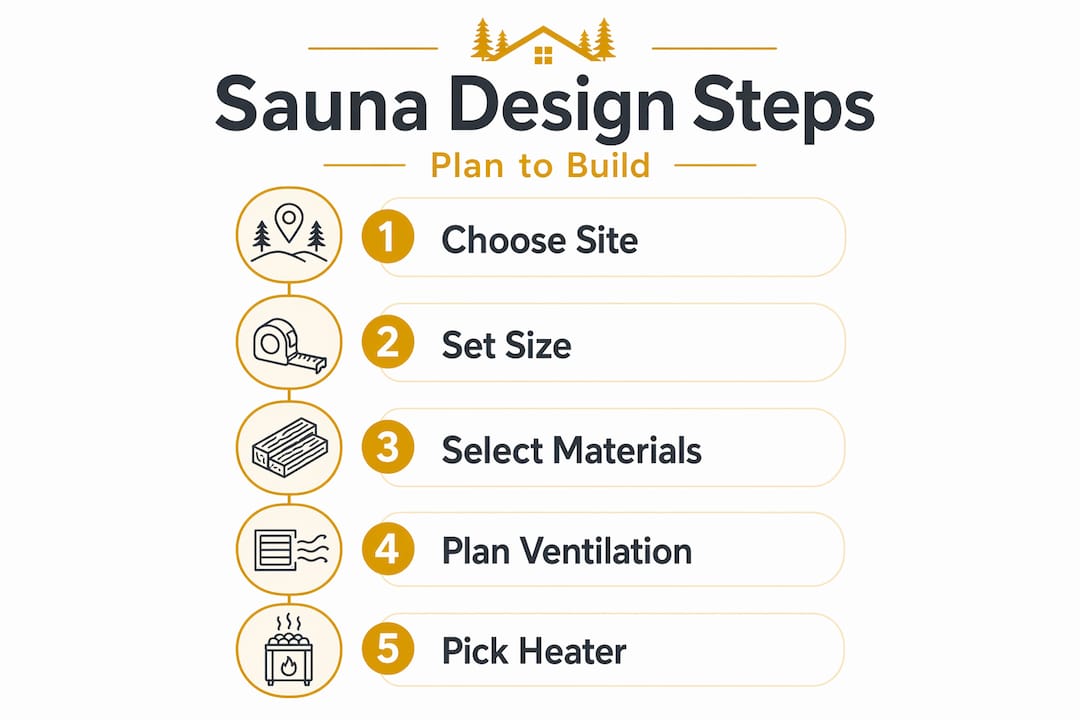
Location choices matter enormously for outdoor saunas in Finland. A south-facing wall reduces heating load in winter. Low-lying or shaded spots trap moisture against the structure and invite wood rot. Proximity to a lake or natural water source adds cultural authenticity and cooling convenience, but you also need easy access to electricity for lighting and heating controls. Slope and drainage should be mapped before any foundation work begins.
Understanding sauna permitting in Finland is not optional. Regulations vary by municipality, but outdoor saunas above a certain floor area almost always require a building permit, and proximity to shorelines triggers additional rules. Getting this sorted before you design saves you from having to redesign later.
| Requirement | Details to confirm |
|---|---|
| Minimum interior floor area | Typically 4 to 6 m² for one to two users |
| Foundation type | Elevated pier or concrete slab for moisture clearance |
| Moisture control layer | Vapor barrier required behind paneling |
| Drainage slope | Minimum 1:50 floor slope toward drain |
| Regulatory check | Local building permit, shoreline rules |
Here are the key pre-build items to address before design work begins:
- Confirm site drainage and soil bearing capacity
- Check utility access (electricity, water for washing area)
- Review local building regulations and apply for permits
- Assess prevailing wind direction to position door and vents
- Decide indoor versus outdoor placement early—it changes almost every other decision
Pro Tip: Always build your outdoor sauna on an elevated foundation with at least 30 cm of clearance from ground level. This single step improves airflow under the structure, prevents ground moisture from wicking into the base logs, and dramatically reduces rot risk over the decades you’ll enjoy the space.
Choosing size and layout: maximize comfort and efficiency
Once you’ve settled your site and requirements, the next crucial step is defining your sauna’s physical footprint and how people will use the space.
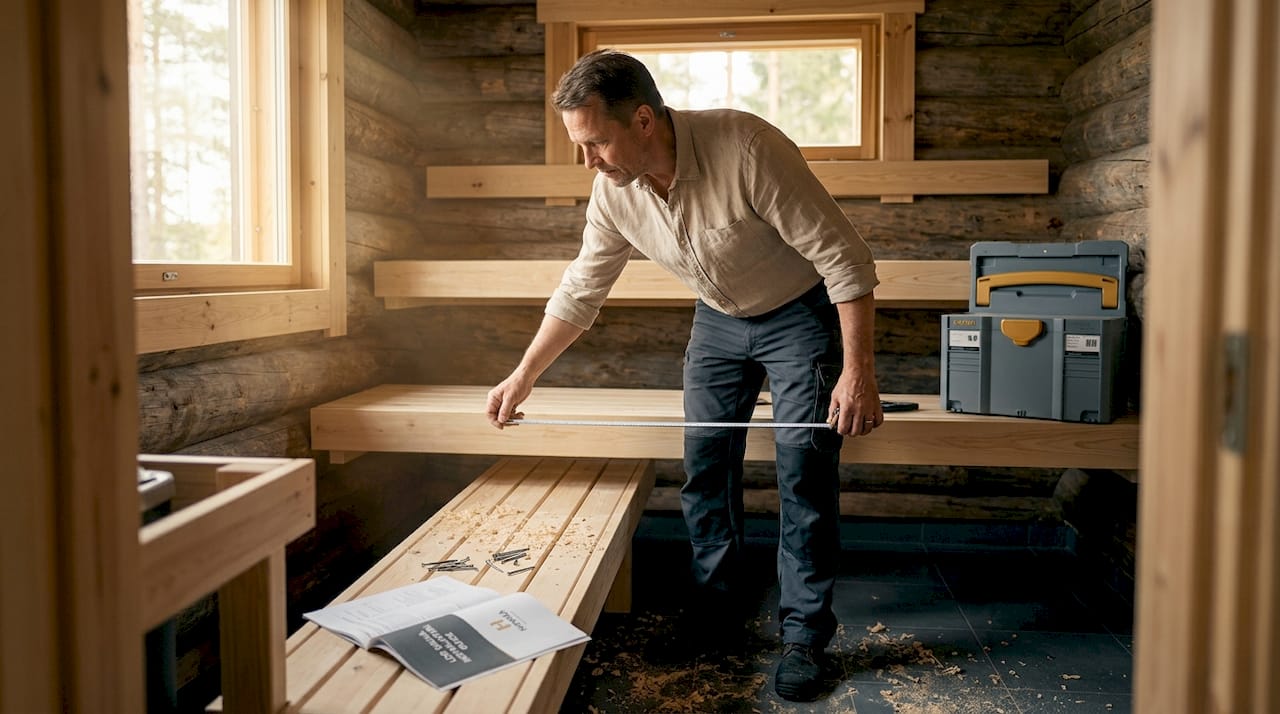
Getting the size right is both a comfort decision and an energy decision. A sauna that’s too large takes forever to heat up and burns through electricity or firewood unnecessarily. A sauna that’s cramped feels stressful rather than restorative. The key variable linking size to energy is the sauna heater sizing benchmark of approximately 1 kW of heater power per 1 cubic meter of room volume, with adjustments upward for glass walls, uninsulated surfaces, or external cold exposure.
Pro Tip: For a typical 8 m³ home sauna—roughly 2 m x 2 m floor plan with a 2 m ceiling—you need about an 8 kW electric heater as a starting point. Add 1 to 1.5 kW if you have a large glass door or window.
| Sauna size | Volume | Ideal for | Pros | Cons |
|---|---|---|---|---|
| Small (2×2 m) | 6 to 8 m³ | 1 to 2 users | Fast heat-up, low running cost | Limited seating flexibility |
| Medium (2.5×3 m) | 12 to 15 m³ | 2 to 4 users | Comfortable family use | Moderate heater and fuel cost |
| Large (3×4 m+) | 18 m³+ | 4+ users or social use | Generous space, flexible bench layouts | Higher energy demand, longer heat-up time |
Layout matters as much as total area. The outdoor sauna step-by-step approach treats bench configuration as a core ergonomic input rather than an afterthought. Standard bench depth is 60 cm for sitting and 90 cm for lying down. The upper bench in a two-tier layout should sit roughly 100 to 110 cm below the ceiling to allow proper heat stratification. Lower benches at around 45 to 50 cm off the floor give users a place to start before moving up.
Bench ergonomics also factor heavily into sauna interior planning, where height and depth are treated as primary design inputs, not decorative choices.
The three most common ergonomic mistakes in sauna layout:
- Benches too narrow (under 50 cm): Users can’t sit comfortably or lie down for extended sessions, reducing the restful quality of every visit.
- Upper bench positioned too close to the ceiling: Less than 90 cm headroom on the upper bench means users can’t sit upright, forcing an uncomfortable crouch in the hottest zone.
- Door placed on the wrong wall: A door directly opposite the heater creates drafts that disrupt even heat distribution and make it difficult to maintain a stable bathing temperature.
Material selection for durability and experience
With your layout defined, turning to the right materials will shape your sauna’s comfort and how long it lasts in Finnish conditions.
Wood species selection is one of the most impactful choices you’ll make. For benches, the priority is low thermal conductivity so the surface never burns bare skin. For walls and ceilings, you want stability under constant heat and humidity cycles. Reviewing your options on common sauna materials will give you a thorough rundown, but here are the proven performers:
- Aspen: Extremely low resin content, stays cool to the touch, smooth grain that resists splinters. Ideal for benches.
- Alder: Similar properties to aspen, lovely light color, very popular in Finnish traditional saunas.
- Spruce: Cost-effective wall and ceiling paneling, good insulating properties, widely available in Finland.
- Pine: Durable for structural elements but releases resin when hot, so avoid it on benches and near the heater.
- Thermo wood (heat-treated timber): Excellent rot and moisture resistance for exterior surfaces and outdoor sauna structures.
Outdoor saunas face significantly more punishing conditions than indoor builds, and outdoor moisture management pushes design toward better moisture barriers, elevated foundations, overhangs for rain shielding, and robust ventilation compared with typical indoor builds. A vapor barrier installed between the inner paneling and insulation layer is non-negotiable. Without it, moisture from löyly (the steam burst created by throwing water on hot stones) penetrates the wall assembly, soaks insulation, and triggers mold growth within a few seasons.
| Material | Durability | Upkeep needs | Feel on skin | Best use |
|---|---|---|---|---|
| Aspen | Moderate | Low | Excellent, stays cool | Benches |
| Alder | Moderate | Low | Excellent | Benches, walls |
| Spruce | Good | Low to moderate | Good | Walls, ceilings |
| Thermo wood | Very high | Very low | Neutral | Exterior, structure |
| Pine | High | Moderate | Avoid on benches | Structure, exterior |
Pro Tip: Avoid any varnished or painted finish on bench surfaces. Chemical treatments release fumes when heated and can irritate skin. Use only natural oils specifically rated for sauna use, or leave bench wood untreated entirely for the most authentic and safe experience.
For custom sauna styles that prioritize longevity, the structural logs or frame timber should be Finnish-grown and kiln-dried to reduce post-installation shrinkage. Seasonal movement in green timber can open gaps in wall paneling and compromise both insulation and vapor barrier continuity.
Ventilation strategy: air quality and moisture control
Perhaps the most overlooked feature—the ventilation system—directly impacts health, comfort, and your sauna’s durability.
A poorly ventilated sauna feels stuffy and suffocating even at moderate temperatures. Worse, moisture that can’t escape accelerates rot in the structure and reduces the life of your insulation significantly. Good Finnish-style outdoor sauna ventilation solves this by using natural convection and deliberate vent placement.
Safety note: Inadequate ventilation in a sauna is not just uncomfortable—it’s dangerous. Without sufficient fresh air exchange, carbon dioxide levels rise, oxygen levels drop, and users can experience dizziness, nausea, or worse. Always design ventilation before you finalize wall positions or buy materials.
Designing natural convection ventilation in five steps:
- Place the fresh air intake vent low on the wall, directly behind or below the heater, at roughly 20 to 30 cm above the floor. This allows cold incoming air to be heated immediately before it enters the bathing zone.
- Position the primary exhaust vent on the opposite wall, near the top of the lower bench level or about 100 cm above the floor. This draws air across the bench area where bathers sit.
- Add a secondary high exhaust vent near the ceiling for the post-bath drying phase. This vent stays closed during bathing but opens afterward to flush moisture out of the room quickly, protecting the structure.
- Size intake and exhaust openings proportionally—typically 200 to 300 cm² each for a small to medium sauna.
- Install adjustable dampers on all vents so you can fine-tune airflow during use and maximize drying speed after each session.
For timber sauna builds in larger or particularly humid environments, passive convection may not be enough. A small extraction fan set to a timer can boost post-bath drying significantly without disturbing the natural airflow pattern during bathing.
Ventilation target: Aim for 6 air changes per hour during active sauna use. This rate maintains oxygen levels, removes excess humidity, and keeps the löyly experience comfortable rather than oppressive.
Designing ventilation around a low intake and opposite exhaust is the key method for preserving the convective airflow pattern that defines traditional Finnish sauna bathing. Get this wrong, and no amount of high-quality wood or an expensive heater will compensate for the discomfort.
Heater selection and integrating all elements
You’re almost ready to build—bring together your choices for size, materials, and ventilation as you select a heater to complete your blueprint.
The heater is the heart of any sauna, but it’s also the last decision you should make, not the first. Every choice that came before—volume, insulation quality, glass area, ventilation setup—feeds directly into the correct heater specification.
Step-by-step heater sizing and selection:
- Calculate your sauna volume: Multiply floor area by ceiling height. A 2.5 m x 2.5 m room with a 2.1 m ceiling equals 13.1 m³.
- Apply the baseline rule: The benchmark for electric heaters is approximately 1 kW per 1 cubic meter of volume, so this example needs about 13 kW minimum.
- Add for heat loss factors: Large glass door? Add 1.5 kW. Single-layer or poorly insulated exterior wall? Add 1 to 2 kW. Your adjusted figure is your target heater output.
- Choose fuel type: Electric heaters offer precise control and are easiest to install. Wood-burning kiuas (the Finnish term for a sauna stove) deliver the most authentic experience and are ideal for off-grid or lakeside builds. Gas heaters are less common in Finland but suit some commercial setups.
- Position the heater in a corner opposite the door to distribute heat evenly across the benches, with adequate stone capacity for meaningful löyly sessions.
Integration checklist before finalizing your plan:
- Confirm air intake vent is positioned behind or below the heater location
- Check that electrical supply capacity matches heater wattage plus lighting loads
- Verify vapor barrier continuity around all penetrations (heater flue, vent ducts, electrical cables)
- Review bench heights relative to your confirmed ceiling height
- Ensure all material choices are compatible with each other (no painted surfaces near raw wood benches, no resin-heavy pine where heat is highest)
Stat callout: Remember the core rule: 1 kW per 1 m³ is your starting baseline, with upward adjustments for any factors that increase heat loss. Undersize the heater and you’ll wait an hour to reach temperature; oversize it and temperature control becomes frustrating.
A Finnish perspective: what most guides miss about truly great sauna design
Most design guides cover the technical checklist and then stop. But after decades of building saunas from Finnish timber, the pattern we see repeatedly is this: the saunas that become true sanctuaries are the ones where the builder respected the sequence of decisions, not just the individual choices.
The biggest gap we see in otherwise well-researched sauna projects is the ventilation adjustment between the bathing phase and the drying phase. During use, your vents should be partially closed to retain heat and let convection work naturally. After the final session, all vents—especially the high drying vent near the ceiling—should open fully to let moisture escape. This two-phase vent management is deeply embedded in unique Finnish sauna features and traditional practice, but almost nobody mentions it in modern build guides. Skip this habit, and you’re adding unnecessary moisture cycles to your structure every single week.
Bench ergonomics also get underestimated. Visitors to a beautifully finished sauna often notice the wood species and the heater brand first, but what they feel in their body is the bench depth and angle. A bench that’s 5 cm too narrow forces awkward posture during long sessions and makes the space feel tiring rather than restorative. When designing log saunas, we always encourage clients to mock up bench height with temporary lumber before finalizing the structure.
Our honest view: never make material or ventilation decisions “by feel” alone. Use the benchmarks in this guide as your starting point, then test actual conditions after a few weeks of use and adjust damper settings, seating positions, and insulation details based on real experience in your specific climate.
Bring your custom sauna vision to life with Finnish expertise
Now that you understand each phase of designing your custom sauna, discover how to make your vision a reality backed by Finnish craftsmanship and expertise.
Huvila Seppälä has spent over 65 years crafting timber structures from Finnish wood, tailored to each client’s individual plans. Whether you’re starting from an idea on paper or a fully developed architect’s drawing, our team can turn your vision into a custom sauna built for comfort and durability.
Explore our resources on Finnish sauna craftsmanship to understand what sets authentic Finnish timber construction apart from generic kit builds. If you’re planning a larger property project, our log house planning guide covers the full workflow from site survey to delivery. Request a transparent, no-hidden-costs quote directly through our contact form and get a personalized offer based on your drawings and requirements.
Frequently asked questions
What is the ideal heater size for my custom sauna?
Calculate 1 kW per 1 m³ of sauna volume as your baseline, then add extra capacity for glass surfaces, poor insulation, or exposed exterior walls in cold climates.
How should sauna ventilation be placed for best results?
Position the fresh air intake below the heater and the exhaust vent on the opposite wall near upper bench height, and add a high ceiling vent specifically for post-bath drying.
Which materials are best for sauna benches?
Aspen and alder are the top choices because they stay cool to the touch, resist splinters, and hold up well under repeated heat and humidity cycles without releasing harmful resins.
How often should sauna air be changed during use?
Aim for 6 complete air changes per hour during active sauna use to keep oxygen levels healthy, maintain comfort, and remove excess moisture from the bathing space.
Recommended
- How to Design Custom Saunas for Your Dream Outdoor Retreat – Hirsitalot, pihasaunat ja piharakennukset kotimaisesta hirrestä
- Expert Guide to Planning a Sauna Project for Your Home – Hirsitalot, pihasaunat ja piharakennukset kotimaisesta hirrestä
- Setting Up Finnish Sauna: Complete Step-by-Step Guide – Hirsitalot, pihasaunat ja piharakennukset kotimaisesta hirrestä
- How to Build Outdoor Sauna for Custom Finnish Style – Hirsitalot, pihasaunat ja piharakennukset kotimaisesta hirrestä