
Finland sauna permits 2026: step-by-step guide
Imagine you’ve spent months planning your dream outdoor sauna, picked the perfect Finnish timber, and are ready to break ground — then your municipality flags a violation before you’ve even poured the foundation. Permit surprises are one of the most common (and costly) setbacks for Finnish homeowners tackling sauna projects. The good news: Finland’s updated construction law, in effect since January 1, 2025, has simplified the rules significantly. This guide walks you through exactly when you need a permit, what local rules still apply regardless, and how to keep your custom wooden sauna build on track from day one.
Table of Contents
- Understanding permit rules for sauna projects in Finland
- Local rules that still apply (even without a permit)
- Sauna permit process: Application, fees, and timing
- Compliance checklist for custom wooden sauna builds
- Common mistakes and how to avoid costly violations
- Why Huvila Seppälä is the right partner for your sauna project
- Frequently asked questions
Key Takeaways
| Point | Details |
|---|---|
| No permit for small saunas | Outdoor saunas up to 30 m² and 120 m³ don’t require a permit if not used as a dwelling. |
| Local rules still apply | You must follow municipal setback, zoning, and fire safety standards on every build. |
| Permit process is online | If your sauna requires a permit, apply via Lupapiste.fi with fees typically between 200 to 700 EUR. |
| Use compliant materials | Custom wooden saunas must use Nordic timber, proper insulation, certified stoves, and documented fire safety. |
| Homeowner is responsible | Violations may lead to fines or demolition—always check with your local authority before starting. |
Understanding permit rules for sauna projects in Finland
Before you design your sauna project, it’s vital to understand the exact situations where a building permit applies — or is no longer needed.
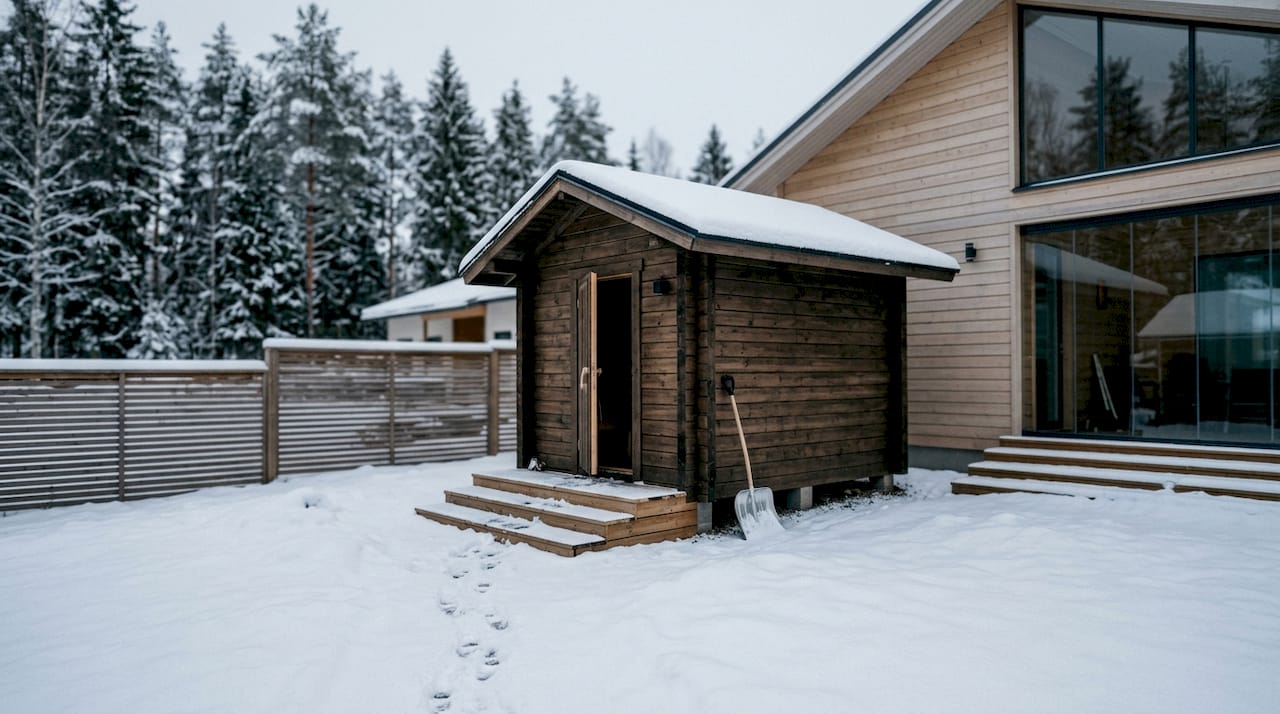
Finland’s changes in construction law have made life easier for many homeowners. Under Rakentamislaki 751/2023, outdoor saunas under 30 m² and 120 m³ do not require a building permit, provided the structure is not used as a dwelling. That last part matters more than most people realize.
A “dwelling” in legal terms means a space with fixed cooking facilities — a full kitchen or a cooking stove, not just a kiuas (sauna heater). A changing room with a small sink does not automatically make your sauna a dwelling. But add a proper kitchen stove and you’ve crossed the line into permit territory, regardless of size.
For anything larger than 30 m² or 120 m³, or any sauna with cooking facilities, a full building permit is required. Municipal rules can also add extra requirements on top of national law, so always verify locally.
Here’s a quick comparison to keep things clear:
| Feature | Permit-free sauna | Permit-required sauna |
|---|---|---|
| Floor area | Up to 30 m² | Over 30 m² |
| Volume | Up to 120 m³ | Over 120 m³ |
| Cooking facilities | None | Any fixed cooking stove |
| Used as dwelling | No | Yes |
| Typical process | Notify municipality | Full application via Lupapiste.fi |
| Estimated cost | None | 200–700 EUR |
Common myths worth clearing up:
- “Any small sauna is automatically exempt.” Not true if it has dwelling features or sits in a restricted zoning area.
- “I don’t need to tell anyone.” Even permit-free builds may require a written notification to your municipality.
- “National law overrides local rules.” National law sets the floor; local building orders can be stricter.
Reviewing the sauna permit requirements for your specific project type before drawing up plans will save you real headaches later. A solid permit guide for sauna projects can help you map out your exact situation quickly.
Local rules that still apply (even without a permit)
Regardless of whether you need a formal permit, these critical local rules and standards are always enforced.
The biggest misconception after the 2025 law change is that permit-free means regulation-free. It absolutely does not. Your local zoning plan (kaava) and municipal building order (rakennusjärjestys) still govern where and how you can build, and ignoring them can result in a forced demolition order.
Standard rules you must follow even for permit-free saunas include:
- Setback from property boundary: Minimum 4 to 5 meters in most municipalities
- Distance from other buildings: At least 8 to 10 meters from neighboring structures
- Distance from shoreline: Typically 10 to 20 meters, sometimes more in protected areas
- Fire safety: CE-marked kiuas, certified chimney installation, and proper clearances around the stove
- Smoke and noise: Your sauna must not create unreasonable disturbance for neighbors
These local permitting requirements are non-negotiable. You can find detailed regulation examples for specific municipalities to understand what applies in your area.
Critical reminder: Even a permit-free sauna that violates setback distances or fire safety rules can be ordered dismantled at your expense. Local building code compliance is not optional — it’s enforced.
If your planned location puts you closer than 4 meters to a boundary, you have two options: move the sauna or get written consent from your neighbor. Some municipalities also allow a formal exemption application, but approval is not guaranteed. Always check before you build, not after.
Sauna permit process: Application, fees, and timing
If your project does need a formal permit, here’s exactly what to expect from start to finish.
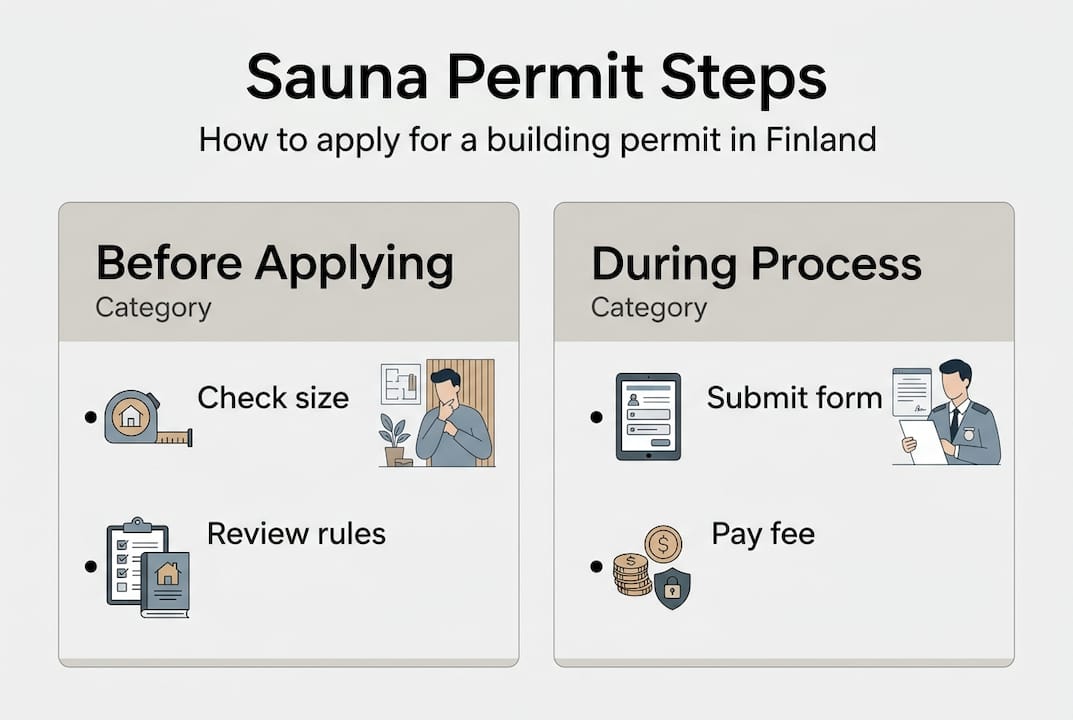
The process is more straightforward than many homeowners expect, especially since Finland centralized most applications through the Lupapiste online portal. Here’s the step-by-step breakdown:
- Prepare your documents. You’ll need a site plan showing the sauna’s location relative to property boundaries, floor plans, elevation drawings, and a description of materials and heating system.
- Submit your application via Lupapiste.fi. Create an account, select your municipality, and upload all required documents. Most municipalities accept digital submissions only.
- Municipality review. Officials check zoning compliance, setbacks, and technical requirements. They may request additional information.
- Possible site inspection. For larger or more complex builds, an inspector may visit the site before approval.
- Permit granted. You receive written approval with any conditions attached. Keep this document on site during construction.
- Final inspection. Once built, a closing inspection confirms the structure matches the approved plans.
Here’s what to expect on costs and timing:
| Factor | Typical range |
|---|---|
| Permit fee | 200 to 700 EUR |
| Processing time | 1 to 3 months |
| Inspection fee | Included or 50–150 EUR extra |
| Validity period | Typically 3 to 5 years |
Fees vary based on sauna size, municipality, and complexity. A compact 35 m² sauna in a rural area will cost less to permit than a larger structure near a protected shoreline.
Pro Tip: Submit your application at least three months before your planned construction start. Some municipalities have backlogs, and starting construction without an approved permit — even accidentally — can trigger fines. Use the building permit process guide to double-check your paperwork before submitting.
Also review the full planning your sauna project checklist early. Getting your architectural drawings right the first time avoids costly resubmissions.
Compliance checklist for custom wooden sauna builds
Once your permits (if necessary) are underway, making sure your wood structure meets technical standards is the next critical step.
Custom timber saunas have specific material and construction requirements that go beyond aesthetics. Getting these right protects your investment, keeps your family safe, and ensures you pass any inspection without issues.
Here’s what your build must include:
- Timber selection: Use knot-free Nordic woods such as spruce, pine, or cedar. These sauna wood requirements matter for heat tolerance and longevity.
- Insulation: Mineral wool insulation with an R-value of R11 to R13 is standard for Finnish sauna walls and ceilings.
- Ventilation: Aim for 3 to 6 air changes per hour to maintain healthy air quality and prevent moisture damage.
- Stove and chimney: Both must carry CE markings. A non-certified kiuas is a fire hazard and will fail inspection.
- Vapor barrier: Install correctly behind the interior paneling to prevent moisture from penetrating the structure.
- Foundation: Even small saunas need a stable, frost-proof base — especially important in Finnish winters.
The full timber sauna setup steps cover each of these points in detail, including specific product standards. For more creative layout ideas, the custom sauna design tips page is worth bookmarking.
Pro Tip: If you’re installing a wood-burning kiuas rather than an electric one, hire a certified chimney sweep or installer. Wood-burning systems require precise clearances and flue sizing that are easy to get wrong — and the consequences range from smoke damage to house fires.
Document every compliance step with photos and receipts. If an inspector visits, having a clear paper trail speeds up the process and demonstrates you’ve taken the rules seriously.
Common mistakes and how to avoid costly violations
Even with simplified permit rules, avoid these mistakes to ensure your sauna journey stays smooth and penalty-free.
The 2025 law change shifted more responsibility onto homeowners. Previously, the permit process itself acted as a compliance checkpoint. Now, for permit-free builds, greater responsibility falls on the homeowner to self-verify compliance — or risk fines and demolition orders.
Here are the most common mistakes Finnish homeowners make:
- Assuming permit-free means no rules. Local zoning and building orders still apply in full. Skipping this check is the single most common error.
- Misjudging setback distances. Many homeowners eyeball the distance to a boundary rather than measuring properly. A few centimeters short can trigger a violation.
- Installing an uncertified stove or chimney. Cheap imports without CE markings are a fire risk and an automatic inspection failure.
- Neglecting fireproofing around the stove. Non-combustible materials must surround the kiuas and chimney penetration points.
- Starting construction before notification. Even permit-free builds in some municipalities require a prior written notification. Check first.
Important: Municipal building control (rakennusvalvonta) can inspect your sauna at any time, even years after construction. If violations are found, you may be ordered to modify or demolish the structure at your own cost. The permit law changes make self-verification more important than ever.
The step-by-step sauna guide walks through each phase of a compliant build, from site selection to final inspection. Using a structured approach from the start is far cheaper than fixing problems after the fact.
Why Huvila Seppälä is the right partner for your sauna project
Navigating permits and regulations is one part of the equation. Building a sauna that actually lasts — one that performs beautifully through Finnish winters and decades of use — is the other.
With over 65 years of experience crafting custom timber structures from authentic Finnish wood, Huvila Seppälä understands exactly what a compliant, high-quality sauna build requires. We work from your drawings, provide transparent quotes with no hidden costs, and deliver fast. Whether you need a compact outdoor sauna or a larger log sauna cabin, our team helps you get the structure right the first time. Visit huvilaseppala.fi to request your personalized offer and take the next step toward a sauna you’ll use for generations.
Frequently asked questions
Do I need a permit for an outdoor sauna under 30 m² in Finland?
No permit is required for outdoor saunas up to 30 m² and 120 m³ as long as the structure is not used as a dwelling, but local zoning and building order rules still apply in full.
What if my sauna is closer than 4 meters to a neighbor’s boundary?
You will likely need written neighbor consent or a formal exemption from your municipality. Always check your local building order before finalizing your site plan.
How much does a sauna building permit cost?
Permit fees typically range from 200 to 700 EUR depending on sauna size, location, and your municipality’s fee schedule.
Can I build an indoor sauna without a permit?
Most indoor sauna installations inside an existing home do not require a separate permit as long as no structural changes are made to walls, floors, or load-bearing elements.
Who checks if my permit-free sauna meets regulations?
Local building control (rakennusvalvonta) has the authority to inspect at any time and can order modifications or demolition if your sauna does not comply with applicable rules.
Recommended
- Requirements for sauna projects in Finland: a complete 2026 guide – Hirsitalot, pihasaunat ja piharakennukset kotimaisesta hirrestä
- Build your Finnish outdoor sauna step by step in 2026 – Hirsitalot, pihasaunat ja piharakennukset kotimaisesta hirrestä
- Permits in sauna building: guide for Finnish homeowners – Hirsitalot, pihasaunat ja piharakennukset kotimaisesta hirrestä
- Setting Up Finnish Sauna: Complete Step-by-Step Guide – Hirsitalot, pihasaunat ja piharakennukset kotimaisesta hirrestä