Role of site planning in construction for Finnish timber homes
TL;DR:
- Effective site planning is essential in Finnish timber projects as it influences permit approval, construction efficiency, and long-term structural quality. A detailed, surveyor-verified site plan ensures compliance with zoning rules, prevents costly delays, and guides safe, organized build processes. Skimping on thorough planning increases risks of delays, errors, and higher costs throughout the project’s lifecycle.
Most Finnish homeowners building a custom log home, cottage, or sauna spend months choosing the right timber species, wall thickness, and roof profile. The site plan? That often gets treated like a formality. Something the architect handles quietly in the background. But the role of site planning in construction is far more central than that assumption suggests. It shapes whether your permit gets approved in three months or drags on for a year. It determines how efficiently your builders work on site. And it directly affects the quality of the finished structure you’ve invested in.
Table of Contents
- What site planning means and why it matters for your timber project
- Site planning’s critical role in Finnish building permits and municipal approval
- How site planning enhances construction logistics, safety, and long-term building performance
- Common pitfalls and how to avoid delays in your site plan and permit process
- How to use your site plan effectively throughout your custom wooden home build
- Why many homeowners underestimate site planning and why that’s a costly mistake
- Explore expert timber building guidance and planning support
- Frequently asked questions
Key Takeaways
| Point | Details |
|---|---|
| Critical permit component | Site plans are mandatory in Finnish building permit applications and influence approval speed. |
| Construction roadmap | Site plans provide a detailed layout that guides logistics, safety, and long-term building performance. |
| Avoid delays | Incomplete or inaccurate site plans often cause permit and construction delays. |
| Expert preparation | Professional architects or surveyors should prepare accurate site plans to ensure compliance. |
| Active use | Use your site plan throughout the build to coordinate work and prevent costly mistakes. |
What site planning means and why it matters for your timber project
A site plan is a scaled technical drawing that shows your property as it exists today and how it will look after construction. It maps property boundaries, existing structures, setback distances, access routes, and the position of your proposed building. As a shared reference point, site plans show existing and proposed property conditions, serving as the roadmap for design, construction, and permitting.
For timber projects specifically, the site plan is more than a formality. It answers questions your builder, your local municipality, and your utility companies all need answered before anyone picks up a tool. Where exactly does the sauna sit relative to the shoreline setback? How does the driveway connect to the public road? Where do the septic systems and water lines run?
Here is what a well-prepared site plan covers for a typical Finnish timber project:
- Property boundaries and legal lot dimensions confirmed against land registry data
- Setback distances from neighboring plots, roads, shorelines, and protected areas
- Location and footprint of all proposed structures including the main building and outbuildings
- Existing features such as trees, topography, drainage ditches, and existing structures
- Access routes for vehicles, emergency services, and construction equipment
- Utility connections including water, sewage, electricity, and heating lines
A weak site plan creates expensive surprises. Builders discover mid-project that the equipment access route was not wide enough. Municipality reviewers request additional documentation. Utility companies find conflicts between planned trenching and existing underground lines. All of these translate to delays and added cost.
Pro Tip: Think of your site plan as a GPS for your entire project. The more accurate and detailed it is before work starts, the fewer costly detours you face during construction.
For a broader picture of how site planning fits into the full build sequence, the step by step timber building guide on the Huvila Seppälä site walks you through each phase from land selection to handover.
Site planning’s critical role in Finnish building permits and municipal approval
With a clear understanding of what a site plan entails, it’s essential to see precisely how it influences the Finnish permit process for your custom timber home.

In Finland, building a new home, cottage, or sauna requires a rakentamislupa (building permit) before any construction starts. The permit application is a package of documents, and the site plan is one of the mandatory principal drawings. Miss it or submit a poorly prepared version, and the municipality cannot complete its review.
Site plans are mandatory principal drawings in Finnish permit applications and directly affect municipal decisions on buildability and compliance with local zoning rules.
Here is the standard sequence for preparing and submitting your permit application in Finland:
- Confirm site ownership and zoning status. Obtain the latest cadastral map and check your local detailed plan (asemakaava) or master plan (yleiskaava) to understand what is permitted on your lot.
- Commission architectural drawings. Your architect prepares the principal drawings: site plan, floor plans, elevations, and cross-sections. The site plan must match the current cadastral data exactly.
- Identify deviations early. If your planned structure requires exceptions to zoning rules (setback deviations, shoreline permits), these need separate applications that add time. Starting this process early is critical.
- Compile supporting documents. Proof of site control, structural calculations, energy efficiency data, and a plan for waste management all form part of the full application package.
- Submit digitally via Lupapiste. Finland’s national permit platform, Lupapiste, handles submission, authority communication, and status tracking in one place.
- Respond promptly to clarification requests. Municipalities contact applicants through Lupapiste when they need more information. Fast, accurate responses keep your timeline moving.
A complete application submitted via Lupapiste can reduce processing time to approximately three months in municipalities like Sipoo, but incomplete or unclear site plans are one of the most common reasons applications stall.
For a detailed walkthrough of the Finnish permit system, the building permit guide Finland and the building permits process Finland guides explain every requirement step by step.
How site planning enhances construction logistics, safety, and long-term building performance
Beyond permits, the site plan guides every step of the build itself, making logistics flow while safeguarding your project and its future use.
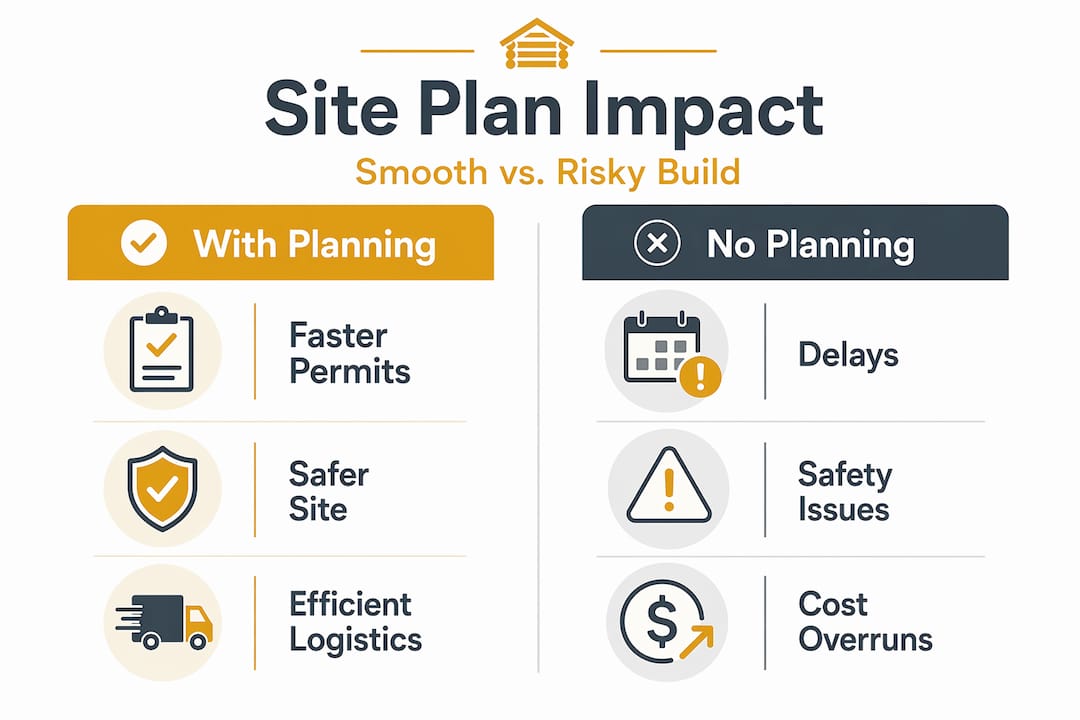
Good site planning organizes the layout of structures, utilities, drainage, and traffic flow to enable safe, efficient construction and prevent future problems. For a timber home in Finland’s varied terrain, this is especially relevant. Rocky ground, high water tables, and tight shoreline plots all require site-specific thinking that only a thorough plan captures.
Practical benefits of thorough site planning during construction:
- Access planning ensures heavy crane and delivery trucks can reach the site without damaging the lot or neighboring property
- Material storage zones are designated in advance, keeping expensive timber dry and accessible without blocking work areas
- Equipment movement paths are defined, reducing the risk of accidents between machines and workers
- Utility coordination maps all underground lines before any digging starts, preventing costly clashes with electrical or water infrastructure
- Stormwater drainage is designed into the site layout, protecting the foundation and surrounding landscape from water damage over the long term
| Construction factor | With thorough site planning | Without thorough site planning |
|---|---|---|
| Permit processing time | ~3 months (complete application) | 6+ months (rework requests) |
| On-site material delays | Rare (storage zones pre-planned) | Common (no designated areas) |
| Utility excavation conflicts | Avoided (locations confirmed early) | Frequent (expensive to fix) |
| Safety incidents | Reduced (traffic zones defined) | Higher risk (ad-hoc routing) |
| Drainage and foundation issues | Mitigated by pre-designed drainage | Discovered post-construction |
Pro Tip: Confirm underground utility locations with your energy and water companies before groundwork begins. In Finland, this service is often free and takes only a few days. Finding a water pipe mid-excavation costs far more than asking beforehand.
The structural quality that comes from thoughtful planning extends well beyond the build phase. If you’re curious about why handcrafted timber structures benefit so much from precise site coordination, that resource explains the connection between planning quality and craftsmanship outcomes.
Common pitfalls and how to avoid delays in your site plan and permit process
Understanding challenges is half the battle; now let’s explore how to proactively avoid these common traps in your project.
Incomplete or inaccurate site plans frequently cause delays through additional municipal information requests and extended processing times. These delays are almost always avoidable with the right preparation upfront.
The most common mistakes Finnish homeowners make in this process:
- Missing or outdated boundary data. Using an old cadastral map that does not reflect recent land divisions or road alignments is one of the fastest ways to trigger a clarification request from the municipality.
- Inaccurate setback calculations. Misjudging shoreline distances or neighbor setbacks is particularly common in cottage and sauna projects near lakes. A surveyor-confirmed boundary check removes this risk entirely.
- Ignoring planning deviations until late. If your design requires a deviation from the local plan, that application runs on a separate, longer track. Homeowners who discover this after submitting their main permit application lose months.
- Poor coordination between architect and builder. When the site plan and the structural drawings are not cross-checked, conflicts appear on site. The sauna ends up in a spot that makes the access route unusable, or the septic system placement conflicts with the planned foundation depth.
- Submitting paper or partial applications. Lupapiste handles everything digitally, and paper submissions through municipalities often face longer queues and higher error rates.
Pro Tip: Book a pre-application meeting with your municipality’s building supervision office (rakennusvalvonta) before finalizing your site plan. This one conversation can clarify setback requirements, flag potential deviation issues, and save you months of back-and-forth after submission.
The timber building permits Finland guide covers the full process with practical checklists designed for homeowners building log or timber frame structures.
How to use your site plan effectively throughout your custom wooden home build
With the pitfalls addressed, here is how to put your carefully crafted site plan to work through your build journey.
Experienced practitioners use the site plan as the single source of truth for equipment access, trenching, and coordination even after the main design is finalized. That means the site plan is not a document you review once and file away. It is a working tool.
Ways to keep your site plan actively guiding the project:
- Share the current approved site plan with every subcontractor before they arrive on site, not just the main builder
- Mark the approved plan with as-built notes when utility trenches, access roads, or storage zones are established in the field, recording any minor deviations immediately
- Review the site plan at three key milestones: groundworks completion, structural frame erection, and before interior fit-out begins
- Use the site plan in conversations with your builder to resolve location disputes before they become construction conflicts
- Keep a printed copy on site at all times during active construction phases alongside the digital version in Lupapiste
During groundworks, confirm that excavation positions match the site plan exactly before the concrete is poured. During utility installation, use the plan’s utility layout to verify that trenches are dug in the right locations. These checks take minutes and can prevent repairs that take weeks.
At the final handover, your approved site plan becomes part of your property’s permanent documentation. You will need it if you ever extend the building, sell the property, or apply for additional permits.
The log house planning workflow guide shows how this documentation fits into the broader project management sequence for Finnish timber builds.
Why many homeowners underestimate site planning and why that’s a costly mistake
There is a persistent belief among first-time custom home builders that the structural drawings carry the project. Floor plans, elevations, timber specifications. That is where the design lives, the thinking goes, and the site plan is just a map of where to put the building. Fill in the lot outline, mark the corners, submit it, move on.
This mindset is understandable. The site plan looks simpler than the architectural drawings. It does not show the beautiful log wall detailing or the sauna’s birch interior. But it is the one document that ties your entire project to the physical reality of the land. Without it being precise, every other drawing exists in an abstract world disconnected from your actual property.
We have seen the consequences of this approach. A well-designed log cottage delayed by four months because the shoreline setback was measured from the wrong baseline on the site plan. A sauna placement that had to shift three meters after the municipality flagged a drainage easement that was never reflected in the original plan. In both cases, the structural design was excellent. The site plan work was rushed.
“The site plan is where paper meets ground. Get it wrong, and every decision made from that point forward has a chance of failing in the field.” This is a truth that experienced builders, architects, and permit officers repeat consistently, yet it rarely reaches homeowners early enough to change their behavior.
The Finnish craftsmanship tradition that makes log and timber buildings exceptional is grounded in precision and honest materials. That same precision needs to start with the site plan, not with the walls. Investing properly in a thorough, surveyor-verified site plan is not a bureaucratic exercise. It is the first act of craftsmanship in your project.
Homeowners who reframe the site plan this way tend to ask better questions of their architects, catch errors earlier, and arrive at construction with confidence. They also tend to finish on time.
If you want to understand how this planning philosophy connects to your permit documentation, the custom timber building permits guide is a practical place to continue.
Explore expert timber building guidance and planning support
You now understand how critical thorough site planning is to your Finnish timber home, cottage, or sauna project. The next step is putting that knowledge into action with resources built specifically for homeowners building custom wooden structures in Finland.
At Huvila Seppälä, over 65 years of experience in manufacturing Finnish timber frames and log structures goes hand in hand with practical guidance that helps you succeed from the planning stage onward. Whether you are applying for your first building permit or refining your design before submission, the right information makes a measurable difference.
Next steps to move your project forward:
- Read the comprehensive timber homes building permits guide to understand every permit requirement for Finnish log and timber construction
- Learn how architecture’s role in timber building connects design decisions directly to structural quality and permit compliance
- Discover why building with timber delivers ecological, thermal, and quality advantages that make it a lasting choice for Finnish homes and cottages
- Contact Huvila Seppälä directly to request a personalized quote based on your own drawings, with no hidden costs and fast delivery times
Frequently asked questions
What is a site plan and why is it required for building permits in Finland?
A site plan is a detailed drawing showing your property boundaries, existing structures, and proposed changes. Finnish building permits require it because site plans are mandatory principal drawings that authorities use to assess compliance with zoning and construction regulations before approving your application.
How long does it take to get a building permit in Sipoo with a complete site plan?
With a complete and carefully prepared site plan submitted via Lupapiste, permit processing takes approximately three months in Sipoo, provided the application includes all required documents and raises no outstanding compliance questions.
Can a poorly prepared site plan delay my construction project?
Yes. Incomplete or inaccurate site plans trigger additional municipal information requests, which pause processing and can extend your permit timeline from three months to six months or longer, delaying construction start.
Who typically prepares the site plan for a timber home construction in Finland?
Site plans are usually prepared by architects, engineers, or surveyors working in close coordination with the builder to confirm that the planned structure’s position, access, and utilities align with both the physical site and regulatory requirements.
How does site planning improve construction site safety?
Site plans organize access routes, equipment zones, and utility locations before work begins, which minimizes the risk of accidents between vehicles and workers and ensures that all construction activity follows a defined, safe sequence from day one.